

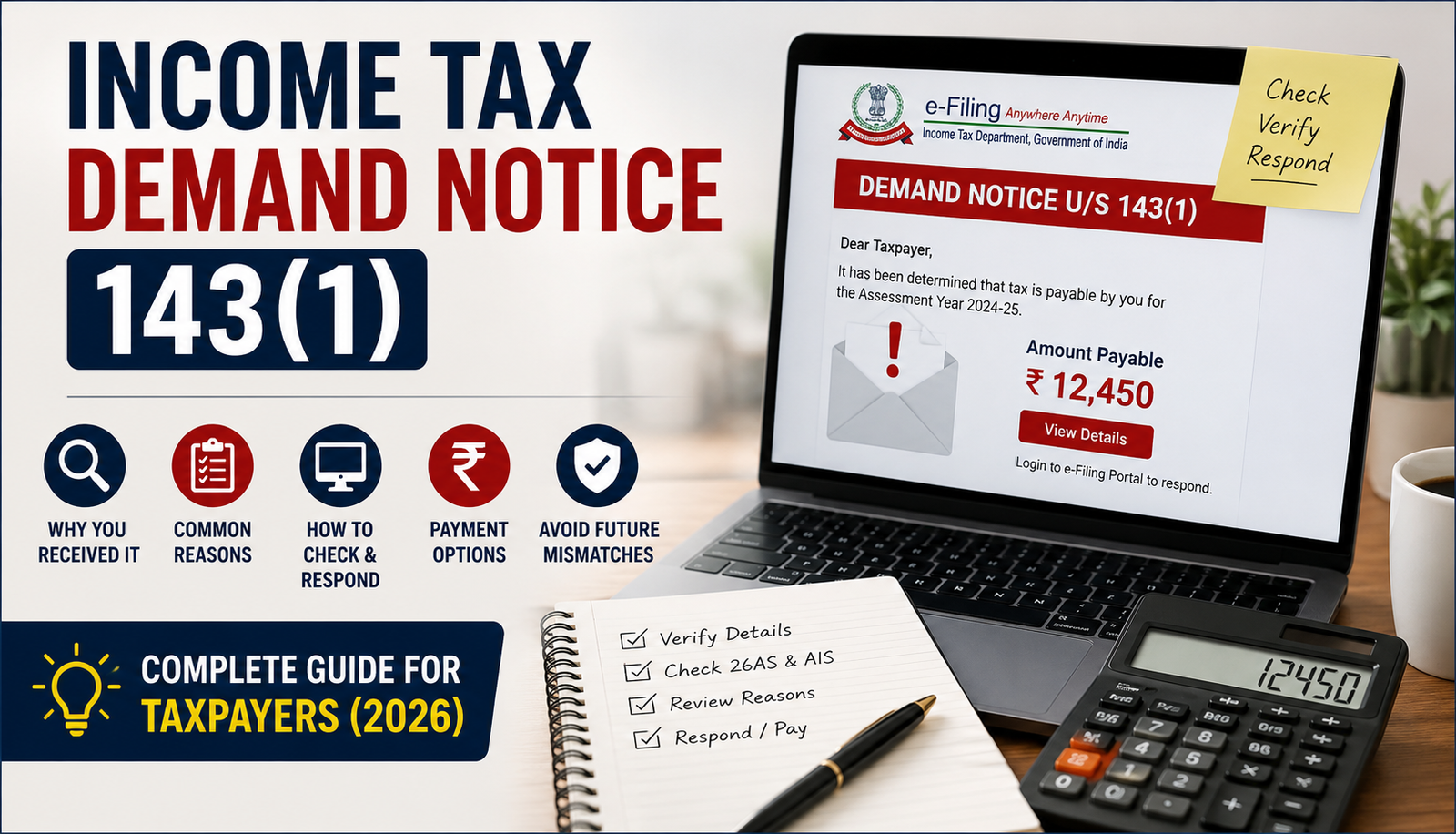
Receiving an email or SMS from the Income Tax Department saying that a demand has been raised for Income Tax Demand Notice under Section 143 1. The first thought that comes to mind is usually, “Did I make a mistake while filing my Income Tax Return (ITR)?”
The good news is that an Income Tax Demand Notice under Section 143 1 does not always mean you’ve done something wrong. In many cases, it is simply the result of a mismatch between the information you submitted in your ITR and the records available with the Income Tax Department.
For example, your employer may have updated your TDS details after you filed your return, or you may have accidentally entered an incorrect tax amount while filing. Even a small calculation error can generate a tax demand.
Instead of panicking, the best approach is to understand why the notice has been issued, verify the details, and respond accordingly. In this guide, we’ll explain everything in simple language so that even a first-time taxpayer can understand what an Income Tax Demand Notice 143(1) means and how to deal with it.
What Is an Income Tax Demand Notice under Section 143 1?
After you file your Income Tax Return, the Income Tax Department doesn’t immediately accept it as final. Instead, your return goes through an automated verification process under Section 143(1) of the Income Tax Act, 1961.
During this process, the department compares the information you provided with the data already available in its system. This includes:
- Tax Deducted at Source (TDS)
- Tax Collected at Source (TCS)
- Advance tax payments
- Self-assessment tax
- Interest income reported by banks
- Salary details
- Information available in Form 26AS
- Annual Information Statement (AIS)
- Taxpayer Information Summary (TIS)
Once the verification is complete, the department sends an Intimation under Section 143(1).
This intimation can have one of three outcomes.
| Result | Meaning |
|---|---|
| No Demand, No Refund | Everything matches correctly. |
| Refund | You have paid more tax than required. |
| Demand Payable | Additional tax is payable due to differences found during processing. |
So, receiving a Section 143(1) intimation is completely normal. The only thing that matters is what the intimation actually says.
What Does “Demand Payable” Mean?
If your intimation mentions Demand Payable, it means the Income Tax Department believes you still owe some amount of tax.
This doesn’t necessarily mean you’ve intentionally underpaid taxes.
The demand may arise because of:
- Incorrect tax calculation
- Mismatch in TDS
- Missing income
- Wrong deduction claim
- Data available with the department after you filed your return
Sometimes the difference may be only a few hundred rupees, while in other cases it can be much higher.
That’s why you should always verify the notice before making any payment.
Why Do You Receive an Income Tax Demand Notice 143(1)?
There isn’t just one reason.
The Income Tax Department compares multiple data sources before processing your return. Even a small mismatch can create a demand.
Let’s understand the most common reasons.
1. TDS Mismatch
This is probably the most common reason behind a Section 143(1) demand notice.
Suppose your employer deducted ₹48,000 as TDS, but while filing your ITR, you accidentally entered ₹58,000.
The Income Tax Department will compare your claim with Form 26AS.
Since only ₹48,000 is available in government records, the extra ₹10,000 claimed by you will be disallowed, resulting in additional tax demand.
2. Interest Income Was Not Reported
Many taxpayers believe that money lying in their savings account doesn’t generate taxable income.
However, banks report interest earned on:
- Savings accounts
- Fixed deposits (FDs)
- Recurring deposits (RDs)
If you forget to include this income while filing your ITR, the department may add it during processing and calculate additional tax.
3. Calculation Mistakes While Filing ITR
Although online filing portals automatically calculate tax, manual errors still happen.
Common examples include:
- Wrong tax payable
- Incorrect rebate calculation
- Wrong surcharge
- Incorrect cess calculation
Even a small mathematical error can lead to a demand notice.
4. Wrong Deduction Claimed
Sometimes taxpayers claim deductions without proper eligibility.
Examples include:
- Section 80C
- Section 80D
- Home loan interest
- HRA exemption
- Donations under Section 80G
If the deduction claimed doesn’t match the information available with the department, your taxable income increases, resulting in additional tax.
5. Advance Tax or Self-Assessment Tax Not Considered
Many people pay tax before filing the return but accidentally:
- enter the wrong challan number,
- select the wrong assessment year,
- or forget to report the payment altogether.
As a result, the department cannot match the tax paid with your return and raises a demand.
6. Employer Revised TDS Return
Imagine you filed your ITR in July using Form 16.
Later, your employer corrected an error and filed a revised TDS return.
Now, the Income Tax Department has updated information, but your ITR still contains the old figures.
This mismatch may generate a demand even though you filed your return correctly based on the information available at that time.
7. Income Reported by Other Institutions
Today, financial institutions report many transactions directly to the Income Tax Department.
These include:
- Banks
- Mutual fund companies
- Stock brokers
- Employers
- Property registrars
- Financial institutions
If you forget to disclose any taxable income that has already been reported by these entities, the department can detect the mismatch automatically.
A Simple Real-Life Example
Let’s understand this with an example.
Rohit works in a private company in Delhi.
He filed his Income Tax Return using his Form 16.
While filing, he forgot that he also earned ₹18,500 as interest from his fixed deposits.
Since the bank reported this interest income to the Income Tax Department, the system detected the difference during processing.
A few weeks later, Rohit received an Intimation under Section 143(1) showing a tax demand of ₹3,850 along with applicable interest.
Initially, he thought it was a serious legal notice.
After checking the details carefully, he realized that the department’s calculation was correct. He paid the amount online, downloaded the challan, and the matter was resolved.
Situations like these are more common than most taxpayers realize.
Is a Section 143(1) Notice the Same as a Scrutiny Notice?
No.
This is one of the biggest misconceptions among taxpayers.
A Section 143(1) intimation is generated automatically through a computerized system after processing your return.
A scrutiny notice under Section 143(2), on the other hand, is issued when the Income Tax Department wants to examine your return in detail.
The difference is significant.
| Section 143(1) | Section 143(2) |
|---|---|
| Computerized processing | Detailed scrutiny assessment |
| Mostly automated | Manual examination by tax authorities |
| Can result in refund, no demand, or demand | Requires supporting documents and explanations |
| Very common | Issued only in selected cases |
Receiving a Section 143(1) notice does not automatically mean your return has been selected for scrutiny.
How to Check an Income Tax Demand Notice Online
If you’ve received an email or SMS about a demand notice, don’t rely only on the message. Always verify the details on the Income Tax e-Filing portal.
The process is straightforward:
- Log in to your Income Tax e-Filing account using your PAN and password.
- Go to Pending Actions or Response to Outstanding Demand, depending on the portal layout.
- Open the relevant demand notice.
- Check the assessment year, demand amount, and the reason mentioned.
- Compare the figures with your filed ITR, Form 26AS, AIS, and tax payment records before taking any action.
Sometimes taxpayers panic after reading the email, only to discover that the demand has already been adjusted or resolved. Verifying the details first can save unnecessary stress.
What Should You Do After Receiving an Income Tax Demand Notice 143(1)?
The first rule is simple don’t ignore it.
Many taxpayers think that a small demand will disappear automatically. Unfortunately, that’s not how it works. If the demand is genuine and you don’t respond within the prescribed time, the department may charge additional interest, adjust the amount against future tax refunds, or initiate recovery proceedings in certain cases.
Instead, follow a systematic approach.
Step 1: Read the Intimation Carefully
Open the PDF of the Section 143(1) intimation and check:
- Assessment Year (AY)
- Financial Year (FY)
- PAN
- Date of issue
- Demand amount (if any)
- Refund amount (if applicable)
- Reasons for adjustment
Most taxpayers skip the explanation section, but that’s where the Income Tax Department clearly mentions why it has changed your tax calculation.
Step 2: Compare It with Your ITR
Now compare the figures in the intimation with the return you originally filed.
Pay special attention to:
- Gross Total Income
- Total Taxable Income
- Deductions claimed
- TDS claimed
- Advance tax
- Self-assessment tax
- Interest income
- Tax liability
Even one incorrect figure can explain the entire demand.
Step 3: Verify Form 26AS and AIS
Before assuming that the department is wrong, verify your tax records.
The most important documents are:
| Document | Why It Matters |
|---|---|
| Form 26AS | Shows TDS, TCS and tax payments |
| Annual Information Statement (AIS) | Shows salary, bank interest, investments and other financial information |
| Taxpayer Information Summary (TIS) | Summarises the information available in AIS |
| Form 16 | Salary and TDS details from employer |
| Interest Certificates | Income from banks and FDs |
These documents usually reveal where the mismatch has occurred.
What If the Department Is Correct?
Sometimes, after checking all the records, you’ll realise that the Income Tax Department’s calculation is actually correct.
Maybe you forgot to include:
- FD interest
- Savings account interest
- Rental income
- Dividend income
- Capital gains
- Other taxable income
Or perhaps you claimed excess TDS or deductions by mistake.
In such situations, the best option is to pay the outstanding demand as soon as possible.
Delaying payment can increase your liability because interest may continue to apply under the Income Tax Act.
What If You Disagree with the Demand?
This happens quite often too.
For example:
- The department ignored your tax payment.
- Your employer filed a revised TDS return after your ITR.
- The bank uploaded incorrect information.
- Tax has already been paid but wasn’t matched.
- Duplicate income has been considered.
If you have documentary proof, you can submit an online response explaining why you disagree.
You don’t have to pay immediately if the demand is genuinely incorrect.
However, make sure your response is supported with proper documents.
How to Respond to an Outstanding Demand Online
The Income Tax Department has made the process fairly simple.
Once you log in to the Income Tax e-Filing portal:
- Open the Outstanding Demand section.
- Select the relevant demand.
- Click Submit Response.
- Choose whether you Agree or Disagree with the demand.
- Upload supporting documents if required.
- Submit the response.
- Download the acknowledgement.
Always keep a copy of the acknowledgement for your records.
Documents You Should Keep Ready
Before responding, collect all relevant tax documents.
| Document | Purpose |
|---|---|
| Filed ITR | Compare original return |
| ITR Acknowledgement | Proof of filing |
| Form 16 | Salary verification |
| Form 26AS | TDS verification |
| AIS | Income verification |
| TIS | Summary of reported income |
| Challans | Proof of tax payment |
| Bank Interest Certificate | Verify interest income |
| Investment Proofs | Support deduction claims |
Having everything in one place makes it much easier to understand whether the demand is justified.
Can You Ignore a Section 143(1) Demand Notice?
Technically, you can ignore it.
Practically, you shouldn’t.
Ignoring the notice can create unnecessary complications later.
Possible consequences include:
- Interest on outstanding tax
- Adjustment against future refunds
- Demand remaining outstanding in your tax account
- Recovery proceedings in certain cases
Even if the amount is small, it is always better to resolve it promptly.
Can Your Refund Be Adjusted Against the Demand?
Yes.
Suppose:
- You have a pending demand of ₹4,500.
- This year, you’re eligible for a refund of ₹8,000.
The Income Tax Department may adjust the outstanding demand against your refund.
In this example:
| Refund Eligible | ₹8,000 |
|---|---|
| Outstanding Demand | ₹4,500 |
| Refund After Adjustment | ₹3,500 |
That’s why it’s always a good idea to clear incorrect or pending demands before filing your next return.
How Long Do You Get to Respond?
The response timeline may vary depending on the type of communication and the instructions mentioned in the intimation.
As a practical rule, don’t wait until the last date.
Respond as soon as you’ve verified your records.
An early response helps avoid unnecessary delays, interest, or future complications.
Practical Tips to Avoid a Section 143(1) Demand in the Future
While not every demand can be avoided, careful filing significantly reduces the chances.
A few simple habits can make a big difference:
Reconcile Before Filing
Don’t file your ITR based only on Form 16.
Always compare it with:
- Form 26AS
- AIS
- TIS
This ensures you’re reporting the same information that the department already has.
Report Every Source of Income
Many taxpayers report only their salary.
But taxable income may also include:
- Savings account interest
- Fixed deposit interest
- Rental income
- Capital gains
- Freelance income
- Dividend income
Even if tax has already been deducted, the income should generally be reported where applicable.
Double-Check Tax Payments
Before submitting your return, verify that:
- Advance tax is correctly entered.
- Self-assessment tax challans are accurate.
- Assessment year is correct.
- Challan details match the payment receipt.
A simple typing mistake can create an unnecessary demand.
File After All TDS Is Updated
If possible, wait until your employer, bank, or deductor has updated the latest TDS information before filing.
This reduces the chances of mismatches.
Review the Return Before Clicking Submit
Most mistakes happen because taxpayers rush during the last few hours before the filing deadline.
Take ten extra minutes to review every figure.
That small effort can save weeks of unnecessary follow-up later.
Common Myths About Income Tax Demand Notice 143(1)
Myth 1: Receiving a demand means I committed tax fraud.
Not true.
Most demands arise because of routine mismatches or calculation differences.
Myth 2: Every demand notice leads to scrutiny.
Incorrect.
A Section 143(1) intimation is completely different from a scrutiny assessment under Section 143(2).
Myth 3: The Income Tax Department is always correct.
Not necessarily.
Sometimes the department’s records may also contain errors.
If you have valid documentary evidence, you can submit a response.
Myth 4: Small demands can be ignored.
Even a small demand should be verified and resolved.
Ignoring it may create problems when claiming future refunds.
Myth 5: Paying the demand means admitting guilt.
No.
Sometimes paying the demand is simply the quickest way to settle a genuine tax difference.
