

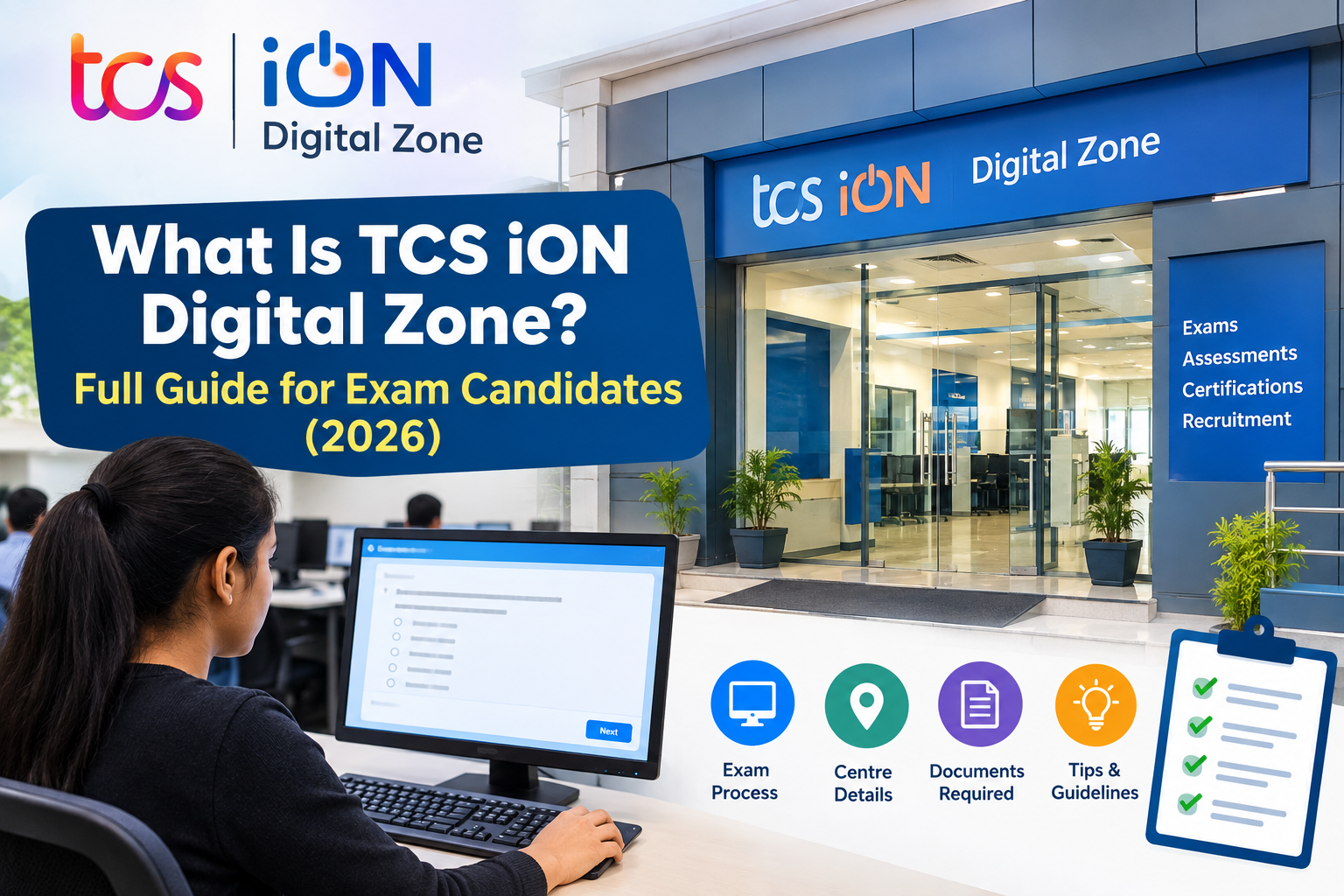
If you landed here because your admit card says “Exam Venue: iON Digital Zone iDZ [some place]” and you’re not sure what that means, you’re not alone. Thousands of candidates search this exact phrase every exam season, usually a day or two before their test, trying to figure out where they’re going and whether it’s even a real place. Let’s clear that up properly.
Table of Contents
ToggleWhat Is TCS iON Digital Zone, Exactly?
Think of TCS iON Digital Zone as a rented, secure exam hall network, not a corporate campus. TCS iON started as a cloud services division of TCS and grew into one of India’s largest digital assessment providers. Over the years, it has run exams for organizations like AIIMS, CBSE, IIT, IIM, and several state governments, along with private company hiring tests.
On your admit card, you’ll usually see the venue written as “iDZ” followed by a location name, for example, iDZ LB Nagar in Hyderabad or iDZ Bopal in Ahmedabad. The “iDZ” is just shorthand for iON Digital Zone. These centers are often located inside partner buildings, training institutes, or commercial complexes, not standalone TCS-branded offices. That’s exactly why so many first-time candidates get confused when they Google the address and find a random building instead of something that looks corporate.
Here’s the part most articles skip: TCS iON does not decide who passes, who gets shortlisted, or what questions appear on your test. If you’re taking the TCS NQT, TCS sets the exam. If you’re taking an RRB exam, the Railway Recruitment Board sets it. TCS iON Digital Zone is simply where the exam happens and who manages the computers, biometric checks, and invigilation on the day.
Is TCS iON Digital Zone Genuine, or Could It Be a Scam?
Short answer: yes, it’s genuine, and no, you don’t need to worry about the concept itself. But you do need to be careful about how you received your admit card.
TCS iON Digital Zone centers are real, TCS-operated infrastructure. The confusion usually comes from two places. First, candidates worry because the venue address doesn’t look like a “TCS building.” Second, some job scams have started using TCS’s name to trick candidates into paying fees or sharing bank details, which makes people rightly cautious, especially since TCS itself dealt with an internal hiring bribery case that made headlines in 2023.
Here’s how to check that your specific admit card is legitimate:
- It should come only from the official portal where you registered for the exam (TCS’s own careers site, the RRB portal, or whichever organization you applied through), never from a random WhatsApp forward or personal email
- A genuine process never asks you to pay money to “confirm” your exam slot or “secure” your seat
- The registration number, exam name, and your personal details on the admit card should match what you submitted during registration
If any of that feels off, don’t proceed. Verify directly on the official website of the organization conducting your exam, not through a search engine ad or a forwarded link.
Which Exams Actually Use TCS iON Digital Zone as a Venue?
TCS iON Digital Zone centers host a wide range of tests, not just TCS’s own hiring exams. Some confirmed examples:
- Company recruitment tests, including TCS NQT (National Qualifier Test), TCS BPS Hiring, and various campus placement drives
- Railway Recruitment Board (RRB) exams, where candidates across the country have reported being allotted iON Digital Zone centers for their computer-based tests
- Institutional and entrance exams for universities and professional bodies that TCS iON has partnered with over the years
One thing worth repeating here: don’t assume every competitive exam board uses TCS iON. Always check your own admit card for the confirmed venue rather than assuming based on what you’ve read online, since exam bodies frequently change their assessment vendors.
Must Read-: ION Digital Zone (IDZ) Jalandhar: Complete Exam Center Guide (Address, Directions & Exam Day Tips)
What to Carry on Exam Day
This list covers what most iON Digital Zone exams typically require, but the exact rules always come from your specific admit card, not from this article or any other blog:
- Printed admit card or hall ticket, exactly as instructed
- A valid, original government photo ID that matches the name on your admit card (Aadhaar, PAN, passport, voter ID, or driving license are usually accepted)
- Any additional documents your specific exam asks for, such as category certificates or passport-size photographs
- A simple pen, only if your admit card mentions you’ll need one for rough work or signatures
Double check the ID requirement especially. A mismatch between your admit card name and your ID (like a maiden name versus a married name) has genuinely turned away candidates at the gate.
What’s Not Allowed Inside
Security at these centers tends to be strict, and for good reason, since these are high-stakes exams. Items that are almost always banned include:
- Mobile phones, smartwatches, and any wearable electronics
- Calculators, unless your specific exam explicitly permits one
- Bags, books, and written notes
- Any loose paper or printed material other than your admit card
Most centers don’t offer safe storage for banned items. Leave your phone and valuables at home or in your bag with someone waiting outside, rather than expecting the venue to look after them for you.
What to Expect Once You Arrive
Walking into an iON Digital Zone for the first time can feel intimidating if you don’t know the routine. Here’s roughly how it goes:
Your admit card will list three different times: reporting time, gate closure time, and test start time. These are not the same thing. Reporting time is when you should arrive. Gate closure time is your hard deadline, after which you will not be let in, even if the actual test hasn’t started yet. Candidates have been turned away for arriving even ten minutes after gate closure, so build in extra travel buffer.
Once inside, expect an ID check, sometimes a photo or biometric capture, and a security pat-down or bag check before you’re allowed near the computer terminals. The environment is quiet, formal, and usually monitored by CCTV. You’ll be assigned a specific system, and staff will guide you if there’s a technical glitch, which does happen occasionally on high-volume exam days.
How to Find Your Exact TCS iON Digital Zone Address
Don’t rely on old lists floating around the internet, including outdated PDFs or forum posts naming specific center addresses from previous years. Exam vendors add, remove, and relocate centers regularly, and using stale information is one of the most common reasons candidates end up at the wrong venue.
The only address that matters is the one printed on your own admit card. A day or two before your exam, look it up on a maps app, check the actual travel time at that hour (not just the distance), and have a backup transport option in mind. Many of these centers are tucked inside commercial buildings or industrial areas, so a little extra time spent locating the entrance is worth it.
FAQs
Is TCS iON Digital Zone a TCS office?
Will I get a TCS job just by visiting an iON Digital Zone center?
Can I reschedule my exam if I miss my slot?
What happens if I forget my admit card?
Is there a dress code?
Disclaimer: This article is for general informational purposes only. Exam center rules, required documents, timings, and center locations vary by exam and can change without notice. Always refer to your official admit card and the website of the exam conducting authority for the most accurate and current instructions. BusinessMust is not affiliated with TCS or TCS iON.
