


If you have searched “business ideas for women” more than once, you already know the problem. You get a list of 15 or 20 ideas, most of them the same five things repeated with different headings, and then you are on your own. Nobody tells you which one actually fits your life, where the money comes from, or what usually goes wrong in month three.
That is the gap this guide is built to close. At BusinessMust, we talk to women at every stage of this journey, from a college student trying to earn her own money to a homemaker restarting her career after eight years, to a woman running a self-help group in a small town who needs ₹50,000 more than she needs another motivational quote. The questions they ask are almost always the same three: which idea suits me, how do I fund it, and what should I actually expect once I start.
This article answers all three. You will get a decision framework to pick the right idea instead of the popular one, more than 30 small business ideas for women organized by category, a real comparison of the government schemes that fund them, the legal and tax basics nobody explains clearly, and an honest section on what tends to go wrong so you are not blindsided by it.
How to Choose the Right Business Idea for You

Most lists ask you to pick a business idea first and figure out the rest later. That is backwards. The businesses that survive past the first six months are usually the ones chosen to fit a person’s actual life, not the ones that looked good on Instagram.
Before you pick anything, be honest with yourself about five things.
How many hours can you genuinely give this, every week, for the next year? Not the hours you have in theory. The hours you have after school pickups, work, or family responsibilities are accounted for. A tiffin service needs someone available every single morning without fail. A content writing business can be done in two-hour blocks whenever they open up.
How much money can you afford to lose completely? Not invest, lose. Every business has a real chance of not working in the first attempt. If losing ₹20,000 would create a serious problem at home, start with an idea that costs under ₹10,000, not one that costs ₹50,000 because it promises higher returns.
Do you want steady income or are you comfortable with slower, bigger upside? Tutoring and tailoring tend to bring in modest but dependable money quickly. Something like a D2C handmade brand or a course business can pay much more, but usually takes longer to become dependable.
Are you better at making something, doing something, or organizing something? Product businesses (baking, jewelry, soaps) need patience with inventory and packaging. Service businesses (tutoring, freelancing, salon services) need patience with people and scheduling. Being honest about which one energizes you rather than drains you will save you months of frustration.
What support do you actually have at home? Not what you wish you had. If nobody can watch your children for two hours in the afternoon, a daycare business you run yourself is a hard start. If your family is skeptical but not obstructive, freelancing from a laptop causes far less friction than a business that turns your living room into a workshop.
Here is a quick way to match your situation to a starting category:
| If you are a… | Start by looking at… | Because… |
|---|---|---|
| Student with a few free hours | Content writing, tutoring juniors, social media management for local shops | Near-zero capital, flexible hours, builds a portfolio |
| Homemaker with young kids at home | Home baking, tailoring, online tutoring, handmade products | Can be done in short windows around childcare |
| Working woman with a side-business goal | Freelance writing/design, digital marketing services, online coaching | Doesn’t need daytime hours, scales without quitting your job |
| Homemaker returning after a career break | Consulting in your old field, upskilling into digital marketing, virtual assistance | Monetizes existing experience faster than starting from zero |
| Woman in a rural area | SHG-linked micro-enterprise, food processing, tailoring, mobile beauty services | Works with lower internet dependency and local cooperative support |
| Freelancer looking to formalize | Registering as a proprietorship, adding retainer clients, packaging services | You already have proof of demand, now build structure |
Still not sure which row fits you? Take BusinessMust’s free business-fit assessment and we will match you to a shortlist based on your hours, budget, and support at home, instead of a generic list.
Low-Investment Business Ideas for Women (Under ₹25,000)
These are the ideas most people start with, and for good reason. Low capital means a low-cost mistake if the first attempt does not work.
Tiffin and meal subscription service. Investment typically falls between ₹5,000 and ₹20,000 for utensils, initial ingredients, and packaging. The real challenge is not cooking quality, it is showing up at the same time every single day. Office workers and students who order tiffins are not looking for the fanciest food, they are looking for someone who never misses a delivery window. Start with 5 to 10 customers in your own residential area before expanding.
Tailoring and alteration services. A sewing machine, basic fabric stock, and some marketing through WhatsApp groups is often enough to start, usually under ₹15,000 if you already have some stitching skill. Specializing (blouse stitching, school uniforms, or ethnic wear alterations) tends to build a reputation faster than offering everything.
Handmade jewelry, soap, or candle making. Raw materials, tools, and packaging usually run ₹10,000 to ₹20,000. The profit margin on handmade goods is genuinely good, but the operational work is in the packaging and shipping, not the making. Underestimating courier costs and breakage is the most common reason margins disappear here.
Social media management for local businesses. This needs almost no capital beyond a laptop and internet you likely already have. Local shops, salons, and small restaurants constantly need someone to run their Instagram and Google Business listing. Offer a free trial month to your first two or three clients, collect a testimonial, and use that to get paid clients.
Freelance content writing. Investment is close to zero. What matters is a small portfolio (even three or four unpaid sample pieces are enough to start) and consistent client outreach. Most people underprice themselves badly in the first few months. Decide on a minimum rate before you start pitching, not after someone offers you less.
Online tutoring. Digital tools like Zoom or Google Meet plus a subject you know well is enough to begin. Specific niches (spoken English, phonics for young children, a specific competitive exam) tend to fill up faster than generic “all subjects” tutoring because parents are searching for exactly that keyword, not a general tutor.
Most of the ideas above can be run from a laptop or a small corner of your home. If you want the fuller picture of options built specifically around working from your house, our dedicated guide to home business ideas for women breaks them down by investment level and space needed.
Home-Based Business Ideas for Women
Home-based is a different question from low-investment. If you are specifically searching for business ideas for women at home, this is the section to focus on: a home daycare or a home bakery, for example, need more upfront money and more physical space planning than a purely digital business does.
Home daycare or after-school activity classes. Working parents in almost every Indian city are actively looking for someone trustworthy to look after young children for a few hours. This needs registration, some basic safety setup, and space in your home, usually ₹30,000 to ₹1,00,000 depending on scale. Trust takes time to build here, so word of mouth from your first few families matters more than advertising.
Home bakery. Specializing early, in eggless cakes, vegan desserts, or kids’ theme cakes for example, tends to work better than trying to cover every dessert category at once. The part that usually breaks a home bakery is not the baking, it is delivery coordination during festive rush periods when ten orders land on the same evening.
Boutique and custom tailoring. If you have a good eye for fashion but not the stitching skill yourself, you can hire a tailor and run the design and customer side of the business. This works particularly well combined with a small Instagram presence showing finished pieces.
Beauty and grooming services at home. Salon services, bridal makeup, or nail art done at clients’ homes or your own has strong demand, especially around wedding season. Investment ranges from ₹20,000 for a basic kit to ₹1,00,000 for professional-grade makeup and salon equipment.
Pet care and grooming. Urban pet ownership has grown significantly, and pet owners tend to be very loyal once they trust someone with their pet. Dog walking, grooming, and pet sitting need modest investment and grow almost entirely through referrals.
Online and Digital Business Ideas for Women
These businesses need a laptop, stable internet, and a way to collect payments online. They also tend to be the easiest to run alongside a full-time job or from a location with limited local market access.
Freelancing in writing, design, or virtual assistance. Platforms like Upwork and Fiverr are a starting point, though most freelancers who last past year one eventually grow through referrals, not the platform itself. The freelancers who scale are usually the ones who stop selling “hours” and start selling clear packages, for example, “12 Instagram posts a month” instead of “social media help.”
E-commerce and niche reselling. Trying to sell everything to everyone is the single most common early mistake. Businesses that focus on one clear category, like maternity wear, regional snacks, or eco-friendly kitchen products, build customer trust faster than a broad general store.
Dropshipping. This removes inventory risk since products ship directly from suppliers, but it lives or dies on supplier reliability. Categories with visual appeal and impulse-friendly pricing (home organization, gifting items, pet accessories) tend to perform better than commodity products.
Blogging or a YouTube channel. This is genuinely low investment (domain and hosting, or a basic camera setup) but slow to pay off. Income comes from ads, sponsorships, and affiliate links once you have built a real, consistent audience, which usually takes several months of regular publishing before it becomes meaningful.
Digital marketing services for small businesses. Nearly every small business owner knows they should be doing more online, and very few have the time to do it themselves. This is one of the more scalable service businesses because once a client trusts you, they tend to stay on a monthly retainer for a long time.
Online coaching or course creation. If you have deep expertise in something, whether it is yoga, a language, an exam, or a professional skill, packaging that into a paid course or coaching program can create a much better margin than one-on-one work, once you have built an audience.
Business Ideas for Women in Rural Areas
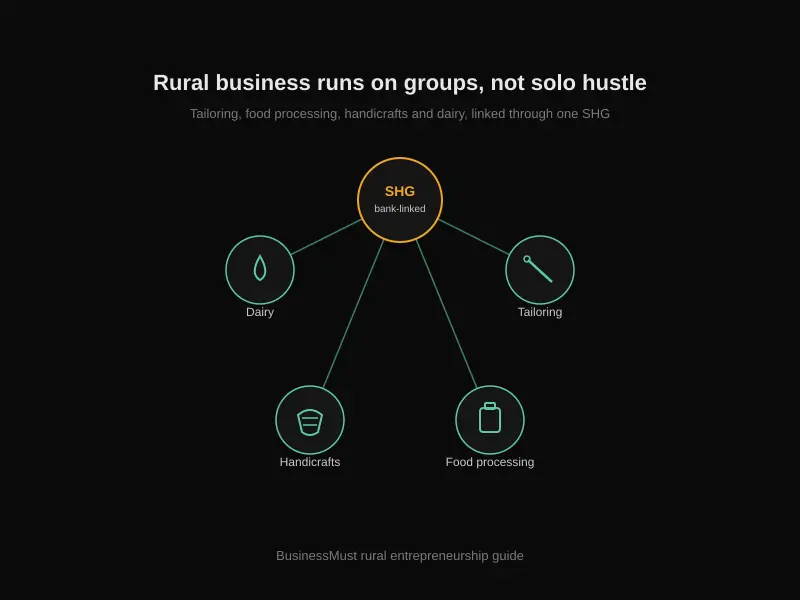
Most business idea lists quietly assume you have fast internet, comfortable English, and access to city wholesale markets. That leaves out a large number of women who are equally capable but working with a different set of resources. This is a genuine gap in how this topic usually gets covered, so it deserves its own real section rather than a single bullet point.
Self-help group (SHG) linked micro-enterprises. Many rural women already have access to an SHG, and SHGs often have an existing relationship with local banks that makes borrowing far easier than applying alone. Group-run businesses in tailoring, food processing, and handicrafts benefit from shared equipment costs and shared customer trust.
Agri-based food processing. Pickles, papad, spices, dairy products, and similar items have consistent local demand and use skills many rural women already have. These businesses typically need very basic equipment and can start by selling through the local market before expanding to nearby towns.
Handicrafts and handloom tied to cooperatives. Working with an existing local cooperative or handloom society for both raw material sourcing and selling access removes two of the hardest parts of starting alone, sourcing and finding a customer base.
Mobile beauty and tailoring services. Rather than a fixed shop, offering beauty or stitching services door to door within a village or small town keeps costs minimal and works even without heavy internet dependency.
Vernacular tutoring and coaching. English-medium tutoring content dominates most tutoring businesses, but there is real and largely unmet demand for coaching in regional languages, particularly for school subjects and competitive exam preparation in Hindi, Marathi, Tamil, Telugu, and other regional languages.
If internet access and digital literacy are limiting factors, the National Rural Livelihood Mission (NRLM) and SHG bank-linkage programs are worth investigating before assuming a business needs to be online to be viable.
Business Ideas for Students and Women Returning After a Career Break
These two groups have almost opposite starting points, but both are usually left out of general business idea lists.
For students: the advantage is time flexibility and low financial pressure, and the disadvantage is limited capital and limited professional network. Content creation, tutoring school-age students in subjects you have recently studied yourself, campus-based reselling of products with genuine demand (stationery, snacks, accessories), and turning a college internship into ongoing freelance work are all realistic starting points that need very little money.
For women returning after a career break: the advantage is real, existing professional skill, and the disadvantage is often confidence and a gap on the resume. Rather than starting completely from zero, the fastest path back to income is usually consulting or freelancing in your previous field. A former HR professional can freelance in recruitment support or policy writing. A former marketing professional can take on freelance campaign work. If your previous field has moved on significantly, a short, focused certification (digital marketing, data analysis, project management tools) is often a faster route back to paid work than a completely new business idea untested by you before.
Government Schemes and Funding for Women Entrepreneurs in India
This is where most business idea articles get vague, mentioning scheme names without real numbers. Here is what each scheme actually offers, as of 2026.
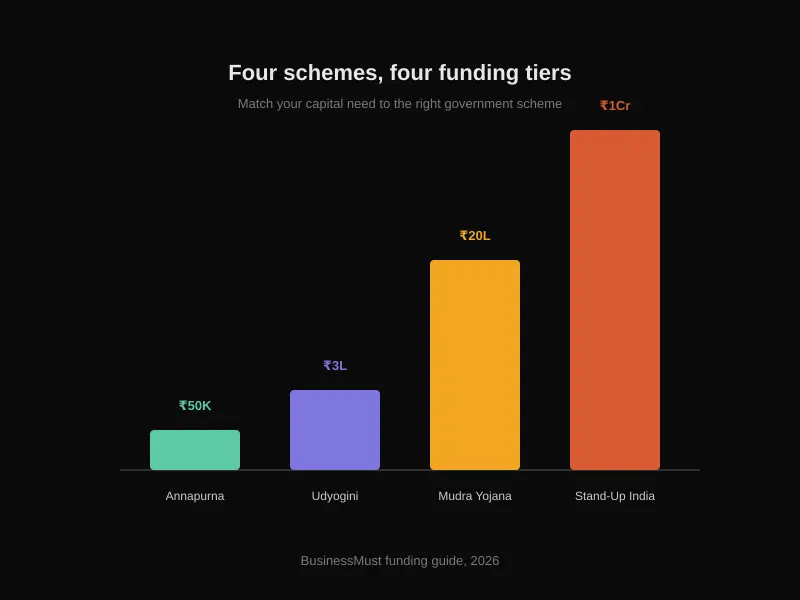
| Scheme | Loan Amount | Interest / Subsidy | Collateral | Best Suited For |
|---|---|---|---|---|
| Mudra Yojana (PMMY) | Shishu: up to ₹50,000. Kishor: ₹50,000 to ₹5 lakh. Tarun: ₹5 lakh to ₹10 lakh. Tarun Plus: ₹10 lakh to ₹20 lakh | Based on the bank’s MCLR plus a spread, no fixed government rate | Collateral-free, backed by the Credit Guarantee Fund for Micro Units | First-time or growing micro-businesses of almost any size, this is the most accessible scheme for most home businesses |
| Stand-Up India | ₹10 lakh to ₹1 crore, composite loan (term loan plus working capital) | Bank-determined, 7-year repayment with an 18-month moratorium | May involve collateral or a guarantee cover depending on the bank | Larger, first-time (greenfield) manufacturing, trading, or services businesses needing more than Mudra covers |
| Udyogini Scheme | Up to ₹3 lakh (originally a Karnataka scheme, since adapted with variations by other states) | Around 30% subsidy for general category, up to 50% for SC/ST women, roughly 6% interest in the originating state | Loans up to ₹1 lakh often need no collateral | Women from economically weaker backgrounds starting small businesses like tailoring, food processing, or retail |
| Annapurna Scheme | Up to ₹50,000 | Market-linked interest rate, first EMI often waived, repayable over 36 months | Usually requires a guarantor | Women specifically starting a food, catering, or tiffin business who need kitchen equipment and raw materials |
| MSME/Udyam Registration | Not a loan itself, but unlocks easier access to other loans | Lower interest rates and collateral-free lending become available once registered | N/A | Any woman-owned business, regardless of size, this should usually be your first step regardless of which loan you pursue |
A practical way to think about this: if your business needs under ₹50,000, start with Mudra’s Shishu category or Annapurna if it is food-specific. If you need ₹50,000 to ₹10 lakh and have some track record, Mudra’s Kishor or Tarun categories fit better. If you are planning something bigger from day one, like a small manufacturing unit, Stand-Up India is designed for exactly that gap. Udyogini is worth checking specifically if you are in a state that runs it or an equivalent state-level scheme, since eligibility and amounts vary by state.
Always confirm current interest rates and terms directly with your bank or the official portal (Udyamimitra, StandUpMitra, or your state’s Women Development Corporation) before applying, since these details are revised periodically.
Legal, Registration, and Tax Basics You Actually Need to Know
You do not need a lawyer to start most of the businesses on this list. You do need to know a few things clearly.
Business structure. Most women starting out register as a sole proprietorship, which is simple and needs minimal paperwork. An LLP or Private Limited structure only becomes worth the extra complexity once you have co-founders, need to raise outside investment, or are operating at a scale where limited liability genuinely matters.
GST registration. You need to register on the official GST portal once your annual turnover crosses ₹40 lakh for goods or ₹20 lakh for services. Below that threshold, most home businesses do not need to register, though some voluntarily register anyway because certain marketplaces and B2B clients require a GST number before they will work with you. BusinessMust’s GST registration walkthrough covers the exact document checklist if you decide to register early.
Udyam (MSME) registration. This is free, done entirely through the Udyam registration portal, and takes about ten minutes. It is not legally compulsory, but it is one of the most useful things a small woman-owned business can do, since it unlocks priority lending, lower interest rates on many loans, and easier access to government tenders.
Presumptive taxation under Section 44AD. If your business turnover is under ₹2 crore, this scheme lets you declare a flat percentage of turnover as taxable income (commonly 8% for cash transactions, 6% for digital transactions) instead of maintaining detailed books and calculating exact profit. For a small home business, this drastically simplifies tax filing. Our tax guide for small business owners walks through how to actually file under this scheme.
A point that genuinely confuses many homemakers: if your business income is added to your spouse’s income for tax filing purposes without a clear paper trail showing it is your own independent business income, it can be clubbed under income tax clubbing provisions in specific situations, particularly with capital gifted by a spouse. Keeping your business income, invoices, and bank account clearly separate from household finances from day one avoids this confusion later. This is worth a short conversation with a tax professional once your income becomes regular, not something to guess your way through.
What Actually Goes Wrong (And How to Handle It)
Every business idea list promises upside. Very few are honest about what actually derails women specifically in the first year. Here is what we see repeatedly.
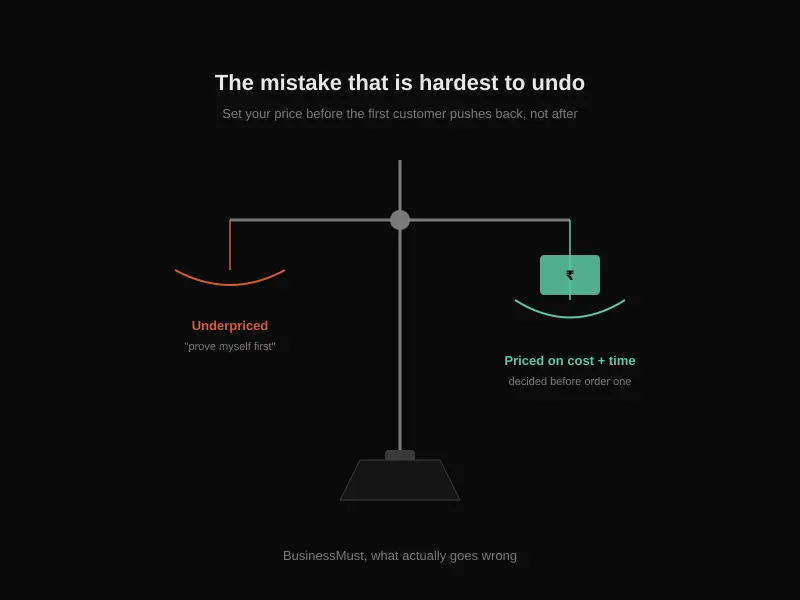
Underpricing out of low confidence, not low value. Many women price their first few orders far below what the work is actually worth, assuming they need to “prove themselves” first. This creates a customer base trained to expect low prices, which is genuinely hard to raise later. Decide your pricing based on your actual costs and time, before you take your first order, not after a customer pushes back.
Inconsistency, not lack of skill, is what usually kills a business. A tiffin service that delivers brilliantly for two weeks and then misses three days because of a family emergency loses customer trust faster than one that delivers reliably at a slightly lower quality. Build in backup plans (a family member who can help on a bad day, a smaller batch size you can always manage) before you scale up.
Family and in-law resistance is real, and it is rarely solved by argument. Many women find that showing consistent, small proof of income, even ₹5,000 in the first month, does more to shift household attitudes than any conversation does. Starting smaller than you want to, specifically so the business does not visibly disrupt the household in its first weeks, is sometimes the practical choice even if it feels slower.
Safety when strangers come to your home. Tutoring, salon services, and daycare all involve inviting unfamiliar people into your home. Verifying new clients through a referral wherever possible, keeping a family member aware of your schedule, and using clear, professional boundaries from the first interaction (fixed timing, advance payment for first-time clients) reduces risk without needing to turn away business.
Treating “side business” as unlimited free time. A business squeezed entirely into the hours after everyone else’s needs are met tends to burn people out within a few months. Block specific hours for your business the same way you would block hours for a job, and protect them.
How BusinessMust Can Help You Get Started
Picking the right idea is the first decision, not the only one. Once you know roughly what you want to start, the next questions are usually about writing a simple business plan, understanding which loan actually fits your situation, and getting the first few customers without spending money you do not have yet.
This is exactly where BusinessMust works with women at every stage of this process, whether you are still deciding between two ideas or you are ready to apply for a Mudra loan and need help getting your paperwork in order. If you want a second opinion before you commit money or time to an idea, book a free consultation with BusinessMust and we will help you think it through properly, idea, funding, and first customers included.
FAQs
Which business is best for women with no investment?
Freelance content writing, virtual assistance, and social media management for local businesses need almost no upfront capital, only a laptop and internet connection you likely already have. The real investment in these is time spent building a small portfolio before your first paid client.
Which business ideas work for women in rural areas?
SHG-linked micro-enterprises, agri-based food processing (pickles, papad, spices), handicrafts connected to local cooperatives, and mobile tailoring or beauty services tend to work well in rural settings because they rely less on heavy internet access and more on local trust and cooperative support structures.
How can a homemaker start a business with no prior experience?
Start with something built on a skill you already use at home, cooking, stitching, or organizing, since this needs less upfront learning. Begin small, with five or ten customers from your own neighborhood or WhatsApp contacts, before expanding, so mistakes are cheap and manageable
What government loans are available for women starting a business?
Mudra Yojana (up to ₹20 lakh across its categories), Stand-Up India (₹10 lakh to ₹1 crore for larger first-time businesses), Udyogini Scheme (up to ₹3 lakh, state-run with variations), and the Annapurna Scheme (up to ₹50,000 specifically for food businesses) are the main options. Which one fits depends mainly on how much capital you need and what kind of business you are starting.
Is GST registration compulsory for a small home business?
No, not until your annual turnover crosses ₹40 lakh for goods or ₹20 lakh for services. Below that, registration is optional, though some businesses register voluntarily if a marketplace or client specifically requires a GST number.
How long does it typically take for a home business to become profitable?
Most low-investment service businesses (tutoring, freelancing, tailoring) can cover their basic costs within the first one to three months if marketed consistently. Product-based or space-heavy businesses (home bakery, daycare, boutique) usually take three to six months to stabilize, since they involve more upfront investment and a longer trust-building period with customers.
Can college students legally start a business in India?
Yes. There is no minimum age requirement to freelance or run a small proprietorship business in India, though formal business loans and certain registrations typically require the applicant to be at least 18. Most students start with freelancing or service work, which needs no formal registration at all until income becomes substantial.
What are the best business ideas for women in 2026?
There is no single best business idea for women, the right choice depends on your available hours, capital, and support at home. That said, tutoring, freelance content writing, tailoring, and digital marketing services currently rank among the best business ideas for women because they combine low starting cost with steady, quick-to-build demand across both cities and smaller towns.
Kam paise mein konsa business shuru karein?
Agar budget kam hai, to tailoring, tiffin service, ya online tutoring achhe options hain. Inme ₹5,000 se ₹20,000 tak ka investment lagta hai, aur ghar se hi shuru kiya ja sakta hai. Sabse zaroori baat yeh hai ki aap consistency maintain karein, jaise tiffin time par deliver karna ya tutoring classes regular lena, kyunki yehi cheez customers ko wapas laati hai.
Ghar baithe mahilaye kaunsa business kar sakti hain?
Home bakery, boutique, handmade jewellery, ya social media management jaise business ghar se hi chalaye ja sakte hain. Inme se digital services (jaise content writing ya social media management) ke liye sirf laptop aur internet chahiye, jabki bakery ya boutique ke liye thoda extra space aur investment lagta hai.
Bina paise ke business kaise shuru karein?
Freelance writing, virtual assistant ka kaam, ya social media management aise business hain jinme almost zero investment lagta hai, bas skill aur thoda time chahiye. Pehle 2-3 clients ko free ya discounted rate par kaam karke dikhaye, testimonial le, aur fir paid kaam dhoondhna shuru karein.
Gaon ki mahilaye kaunsa business start kar sakti hain?
SHG (self-help group) se juda hua business, jaise pickle ya papad banane ka kaam, tailoring, ya handicrafts, gaon mein achhe se chal sakta hain. Inme internet ki zyada zaroorat nahi hoti, aur SHG ke through bank se loan lena bhi aasan ho jaata hai.
Sarkari loan kaise milega business ke liye?
Mudra Yojana sabse aasan option hai, isme ₹50,000 se le kar ₹20 lakh tak ka collateral-free loan milta hai. Agar aap food business shuru kar rahi hain, to Annapurna Scheme bhi dekh sakti hain, jisme ₹50,000 tak ka loan milta hai. Apne nazdiki bank ya Udyamimitra portal par jaa kar apply kar sakti hain.
Conclusion: Your Next Step Starts Today
Reading a business ideas list has never been the hard part. Picking one that fits your actual life, funding it without guessing which scheme applies to you, and staying consistent past the first rough month, that is the real work, and that is exactly what this guide was built to prepare you for.
You do not need to have everything figured out before you start. Pick one idea from the categories above that matches your hours, your budget, and the support you genuinely have at home. Register on Udyam if you have not already, since it costs nothing and opens doors later. Check whether Mudra, Annapurna, or a state scheme like Udyogini fits your funding need. Then start small, with five customers instead of fifty, and let consistency build the rest.
Whether you are a student testing your first freelance gig, a homemaker turning a home skill into steady income, or part of a self-help group ready to formalize what you already do well, BusinessMust is here to help you take that next step. Book a free consultation whenever you are ready to move from planning to starting.
