

Picture this. You applied for one lot of 87 shares at ₹172 each, saw the Western Carriers IPO GMP sitting at ₹62, and quietly counted a profit of about ₹5,400. On listing day, that same lot was worth roughly ₹1,100 less than you paid. The gap between what the grey market promised and what the exchange delivered is the real story of this IPO.
At BusinessMust, where we track IPO GMP and listing performance for Indian investors, we went back through the day-wise grey market premium data, the final IPO subscription status, the listing-day trades and two years of financials to find exactly where the signal broke. Whether you still hold these shares or you check GMP before every IPO you apply for, this breakdown will help you read the next one with sharper eyes.
Western Carriers IPO GMP Day by Day: From ₹30 to ₹62 and Back to ₹15
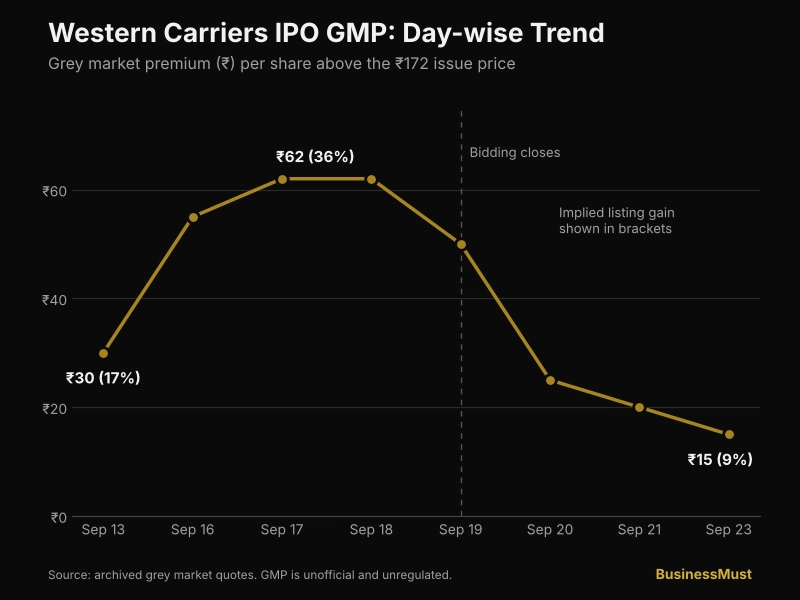
The Western Carriers IPO GMP first appeared at ₹30 when bidding opened, climbed fast as subscriptions poured in, and then unwound just as quickly once the book closed. Here is the full trail:
| Date | GMP | Implied Listing Price | Implied Gain | Subject to Sauda (per application) |
| Sep 13 | ₹30 | ₹202 | 17.4% | Not quoted |
| Sep 16 | ₹55 | ₹227 | 32.0% | ₹3,500 |
| Sep 17 | ₹62 | ₹234 | 36.0% | ₹4,000 |
| Sep 18 | ₹62 | ₹234 | 36.0% | ₹4,000 |
| Sep 19 | ₹50 | ₹222 | 29.1% | ₹2,000 |
| Sep 20 | ₹25 | ₹197 | 14.5% | ₹1,000 |
| Sep 21 | ₹20 | ₹192 | 11.6% | ₹900 |
| Sep 23 | ₹15 | ₹187 | 8.7% | ₹900 |
Implied gain is calculated on the ₹172 upper price band. GMP figures are unofficial grey market quotes.
The turning point is easy to spot. The Western Carriers IPO GMP held at ₹62 while bids were still flowing in. The day subscription closed, it slipped to ₹50, and over the next few sessions it lost roughly three-quarters of its peak value.
A GMP that falls after the order book closes usually tells you something specific: grey market buyers who were happy to pay for allotment are backing out now that they know the final demand. On the eve of listing, even research analysts were pencilling in only a single-digit premium. The final GMP of ₹15 pointed to around 9% upside, and even that turned out to be too hopeful.
Western Carriers IPO Snapshot: Price Band, Lot Size, Subscription and Key Dates
Before judging the listing, it helps to see what investors were actually signing up for. Most retail applicants bid through a UPI mandate on their broker app, a sign of how far digital payments in India have simplified IPO applications.
| Detail | Western Carriers IPO |
| Issue size | ₹492.88 crore (₹400 crore fresh issue plus ₹92.88 crore offer for sale) |
| Price band | ₹163 to ₹172 per share |
| Lot size | 87 shares (₹14,964 at the upper band) |
| Retail maximum | 13 lots, 1,131 shares (₹1,94,532) |
| Bidding window | September 13 to September 19, 2024 |
| Basis of allotment | September 20, 2024 |
| Listing | September 24, 2024 on BSE and NSE (symbol: WCIL) |
| Book running lead managers | JM Financial, Kotak Mahindra Capital |
| Registrar | MUFG Intime India (formerly Link Intime) |
| Selling shareholder | Promoter Rajendra Sethia (54 lakh shares) |
Final subscription status (NSE data): the issue was subscribed 30.57 times overall. Non-institutional investors bid 44.71 times the HNI quota, qualified institutional buyers (QIB) 27.99 times, and retail investors 25.95 times. A day before opening, the company raised ₹147.86 crore from 15 anchor investors at ₹172 per share.
The fresh money was earmarked for three things: about ₹163.5 crore to repay borrowings, about ₹151.7 crore for commercial vehicles, shipping containers and reach stackers, and the rest for general corporate purposes.
Why do websites show different numbers? You will find subscription figures of 22x, 31.6x and 30.57x online. The higher numbers were interim snapshots taken around closing time, while 30.57x is the final exchange figure. Similarly, some pages quote the Western Carriers IPO listing price as ₹171 and others as ₹159. The first is the opening price; the second is where the stock closed that day. Both are correct; they just measure different moments.
Listing Day: How Western Carriers Shares Actually Opened and Closed
Western Carriers listed at ₹170 on BSE and ₹171 on NSE, as reported by Business Standard. That was a small discount to the ₹172 issue price and well below the expected listing price of ₹187 that the final Western Carriers IPO GMP suggested. The stock briefly touched ₹177 in early trade, then sold off steadily to close at ₹159.44 on NSE, a listing loss of about 7.3% instead of the listing gain grey market traders were counting on.
Here is what that meant in rupees for anyone holding a single lot. We call it the GMP versus reality table:
| Scenario | Price per Share | Value of 1 Lot (87 shares) | Profit or Loss per Lot |
| Amount paid at IPO | ₹172 | ₹14,964 | Nil |
| Peak GMP expectation | ₹234 | ₹20,358 | +₹5,394 |
| Final GMP expectation | ₹187 | ₹16,269 | +₹1,305 |
| Listing open (NSE) | ₹171 | ₹14,877 | -₹87 |
| Listing day close (NSE) | ₹159.44 | ₹13,871 | -₹1,093 |
| Recent 52-week high | ₹137 | ₹11,919 | -₹3,045 |
| Recent trading level | about ₹97 | about ₹8,441 | about -₹6,523 |
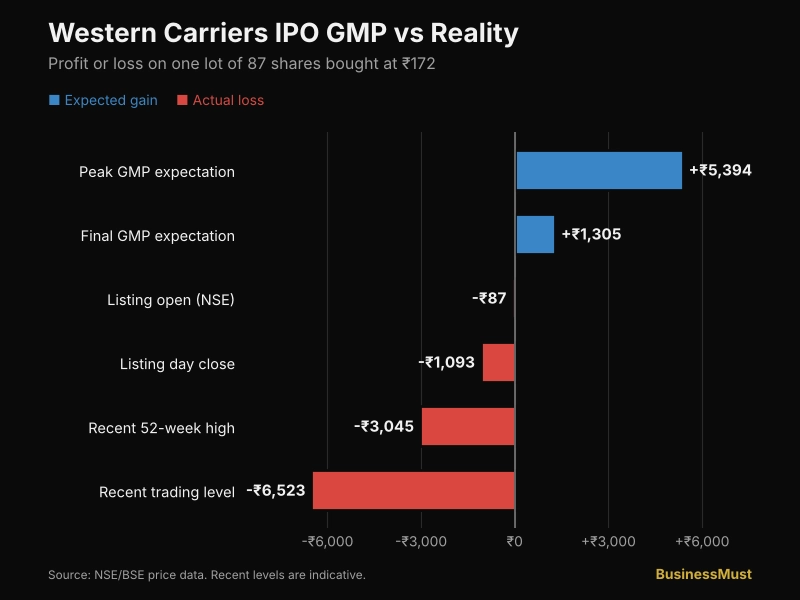
The spread between the best-case grey market expectation and the recent value of the same lot is close to ₹12,000. That is almost the entire amount a retail investor put in.
Try this before your next IPO: run the same per-lot math with the latest GMP and a downside case where the stock lists 10% below the issue price. It takes two minutes and keeps your expectations honest.
Why the Western Carriers IPO GMP Got It Wrong
No single factor explains the miss. A few signals, read together, suggest the grey market was pricing excitement while the fundamentals were telling a quieter story.
1. GMP is a tiny, unofficial market. It runs on a handful of dealers trading small volumes over phone and chat groups. A few large participants can push rates up or down, so GMP reflects mood during bidding, not the stock’s fair value.
2. The valuation left little room for error. At ₹172, the post-issue P/E worked out to roughly 21.8 times FY24 earnings, while the company’s profit after tax margin was just 4.77%. In a low-margin business, even a small rise in fuel, labour or freight costs eats a large slice of profit. Paying 22 times earnings meant investors were already pricing in steady growth.
3. A cash flow warning was sitting in the prospectus. In FY24 the company reported a net profit of about ₹80 crore, yet its operating cash flow was under ₹1 crore. Most of the profit was locked up in money owed by customers and other working capital. Institutional desks read this line closely. Grey market traders rarely do.
4. The subscription mix mattered more than the headline. A 30x subscription sounds strong, but the biggest push came from HNIs at 44.71x. HNI money is often borrowed and aimed at listing gains, so it tends to exit on day one. For comparison, Arkade Developers, which finalised its allotment the same day, was subscribed over 106 times. Next to that, Western Carriers looked like solid demand, not a frenzy.
5. A crowded IPO calendar split investor money. Several issues were open or listing in the same window. When too many IPOs chase the same pool of listing-day traders, weaker debuts get sold harder.
How IPO Grey Market Premium Works: Kostak and Subject to Sauda Explained
If you are newer to IPOs, three terms come up in every GMP discussion. Here they are with the Western Carriers numbers plugged in.
Grey market premium (GMP): the extra amount above the issue price at which dealers agree to buy shares before listing. A GMP of ₹62 meant a dealer was willing to pay ₹234 for a Western Carriers share you had not even received yet.
Kostak rate: a fixed amount a dealer pays for your entire application, whether or not you get allotment. It suits applicants who fear missing out on allotment and want guaranteed cash. No kostak rates were quoted for Western Carriers, which itself hinted that dealers were not confident enough to take on allotment risk.
Subject to sauda: a price paid for your application only if it actually gets allotment. At the peak, the subject to sauda rate was ₹4,000 per application. Since a lot carried an expected profit of ₹5,394 at that point, the dealer was building in a margin of about ₹1,400 for the risk.
One thing every investor should know: the grey market runs outside any stock exchange. SEBI does not recognise or regulate it, there is no written contract, and if a dealer backs out, you have no legal route to recover money. Treat GMP as a sentiment gauge, nothing more. SEBI’s investor education portal is a far better starting point than any Telegram GMP channel. We track how these numbers move for other issues too, such as the BCCL IPO GMP and Metro Brands IPO GMP today, and the pattern of a falling GMP after the book closes shows up again and again.
Western Carriers Share Price After Listing: The Scorecard
The weak debut was only the first chapter. The anchor lock-in worked like this: anchor investors had 50% of their shares locked in for 30 days and the rest for 90 days. Once those lock-ins ended, more shares became free to sell, which often weighs on a newly listed stock.
Over the most recent 52 weeks, the Western Carriers share price has swung between a high of ₹137 and a low of ₹77.02, and it has lately traded around the ₹95 to ₹100 range. Even the 52-week high sits about 20% below the IPO price.
Put another way, the market capitalisation of the whole company was about ₹1,626 crore at the close of listing day. At recent prices, that figure is under ₹1,000 crore. You can check the live WCIL share price on the NSE quote page before making any decision.
What Changed in the Business After the IPO
Share prices follow earnings over time, so this is where the fall makes sense. Western Carriers is a rail-focused, 4PL asset-light multimodal logistics company: it organises freight across rail, road, sea and air while owning only part of the equipment. That model scales quickly, but it leaves margins exposed to freight and handling costs. Revenue kept growing, but profit did not keep up.
| Metric (₹ crore) | FY24 | FY25 | FY26 |
| Net sales | 1,685.8 | 1,725.7 | 1,829.2 |
| Operating profit | 146.2 | 120.6 | 85.4 |
| Operating margin | 8.7% | 7.0% | 4.7% |
| Net profit | 80.3 | 65.1 | 38.8 |
| Operating cash flow | 0.7 | -2.7 | -21.8 |
Sales grew about 8.5% in two years, while net profit fell by more than half. Costs rose faster than revenue, and the operating margin nearly halved. Cash flow from operations, already thin before the IPO, turned negative.
That is not the full picture, though. A few developments point the other way:
- The balance sheet got cleaner. Long-term borrowings dropped from about ₹25 crore to about ₹6 crore, and the fixed asset base roughly doubled as IPO money went into vehicles and containers.
- Promoters are adding, not exiting. Promoter holding has inched up from 71.89% to 73.03%, with zero shares pledged.
- Quarterly profit has steadied. Net profit has held in a band of roughly ₹8 crore to ₹11 crore per quarter over the last five quarters, with the latest quarter at ₹8.69 crore.
- New long-term business is coming in. The company recently won a 15-year contract to operate a general cargo terminal at Kolkata Port and has opened it, alongside a ₹230 crore work order and a new rail terminal and service station in Gujarat, as shared in the company’s investor updates.
So the story is not “the business collapsed.” It is closer to “a decent logistics company was priced for a growth phase that has not shown up in profits yet.”
Risks Most Western Carriers IPO Reviews Skipped
Most pre-listing Western Carriers IPO review pieces focused on the client list and the asset-light model. These are the risks that deserved more attention:
- Very thin margins. Net profit in FY26 was barely 2% of sales, so small cost shocks swing earnings sharply.
- Cash tied up in working capital. Three straight years of weak or negative operating cash flow means growth is consuming cash rather than generating it.
- Dependence on metal clients. A large share of business comes from names like Tata Steel, Hindalco, Jindal Stainless, Vedanta and BALCO. A slowdown in the metals cycle hits volumes directly.
- Rail exposure. As a rail-focused multimodal logistics player, the company depends on rake availability and Indian Railways freight policy, which it does not control.
- Low free float. With promoters holding about 73%, fewer shares trade freely, which can make price moves sharper in both directions.
Holding Western Carriers Shares? A Neutral Checklist
This is not a buy or sell call. If you got allotment and are still holding, these questions can help you decide with a clear head instead of staring at the ₹172 you paid:
- Would you buy this stock today at the current price? If yes, holding is consistent. If no, the only reason to hold is hoping to “get back to ₹172”, which is not a strategy.
- Are margins recovering? Watch the operating margin in each quarterly result. A move back above 6% to 7% would signal real improvement.
- Is operating cash flow turning positive? Profit that converts into cash is the clearest sign of a healthier business.
- How does this position fit your portfolio? If it is a small slice, the decision matters less. If it is a large one, concentration risk deserves more weight than the original issue price.
The tax angle many allottees miss. Shares allotted in this IPO have been held for more than 12 months, so the capital gains tax treatment is long-term. If you sell below cost, you book a long-term capital loss. Here is a real-life style example: say you hold one lot and sell near ₹97, booking a loss of about ₹6,500. If you also booked ₹40,000 of long-term gains on equity mutual funds in the same year, this loss reduces your taxable long-term gains to about ₹33,500.
Long-term capital losses can only be set off against long-term capital gains, and unused losses can be carried forward for up to eight years, provided you file your income tax return by the due date. Check the latest income tax rules and run your numbers through our income tax calculator, or speak to a tax professional before acting. Your broker’s capital gains statement and your Form 26AS and AIS will show the sale, so report the loss correctly. A mismatch between your return and these records is a common trigger for an income tax notice under Section 143(1). You can cross-check your filing on the official Income Tax Department portal.
5 Lessons From This IPO for Your Next Application
The Western Carriers case is useful precisely because it went wrong. Carry these into your next IPO:
- Watch the GMP trend in the final two days, not the peak. A falling GMP after subscription closes is a stronger signal than any high number during bidding.
- Read who subscribed, not just how many times. Heavy HNI demand with modest institutional interest often means fast money that leaves on listing day.
- Check operating cash flow in the prospectus. Profit without cash is the first thing professional investors look for. The RHP filed with SEBI showed this clearly for Western Carriers.
- Compare the P/E with the margin. A 20x plus valuation on a business earning under 5% net margin needs strong growth to justify it.
- Decide your exit plan before listing day. Know in advance whether you are applying for listing gains or for the long term, and the price at which you will sell if the debut is weak. It also helps to know where IPO money fits in your overall finances; a quick net worth calculation keeps each bet in proportion.
Frequently Asked Questions
What was the final Western Carriers IPO GMP before listing?
The last grey market quote before listing was ₹15, implying a listing price of about ₹187, or roughly 9% above the ₹172 issue price. It had peaked at ₹62 during bidding.
What was the Western Carriers IPO listing price on NSE and BSE?
The shares opened at ₹171 on NSE and ₹170 on BSE against an issue price of ₹172. They closed the first trading day at ₹159.44 on NSE, a loss of about 7.3%.
How many times was Western Carriers IPO subscribed?
The issue was subscribed 30.57 times overall as per final NSE data. HNIs bid 44.71 times, qualified institutional buyers 27.99 times and retail investors 25.95 times their reserved portions.
Why did the Western Carriers share price fall after listing?
Profit after tax fell from about ₹80 crore in FY24 to about ₹39 crore in FY26 as costs grew faster than revenue, and operating cash flow turned negative. A rich listing valuation and anchor lock-in expiries added selling pressure.
How accurate is IPO GMP in predicting the listing price?
GMP is a rough sentiment indicator, not a forecast. For Western Carriers, the final GMP of ₹15 pointed to an expected listing price of ₹187, but the stock opened at ₹171, a miss of about 9%. GMP tends to be more reliable when it stays stable in the last two days and institutional demand is strong.
Is IPO GMP legal in India?
The grey market operates outside stock exchanges and is not recognised or regulated by SEBI. Deals happen on trust with no written contract, so investors have no legal protection if a counterparty does not pay.
What is the difference between kostak and subject to sauda?
Kostak is a fixed price paid for your IPO application whether or not you get allotment. Subject to sauda is paid only if your application actually receives shares. For Western Carriers, subject to sauda peaked at ₹4,000 per application and no kostak was quoted.
Is Western Carriers share a good buy now?
That depends on your view of its margins and cash flow. Key things to track are a recovery in operating margin, positive operating cash flow and progress on new contracts such as the Kolkata Port terminal. Consult a SEBI-registered adviser before investing.
Check the GMP Trend Before Your Next IPO
The Western Carriers IPO GMP story proves one thing: the loudest number in an IPO is rarely the most reliable one. Before you block money for your next application, check three things: the GMP trend in the final two days, the QIB subscription, and the operating cash flow in the RHP.
BusinessMust breaks down major Indian IPOs with exactly that data. Bookmark our IPO and investment guides, read our latest IPO GMP analysis before the issue closes, and explore our personal finance guides to plan where IPO money fits in your portfolio.
Data sources: NSE and BSE listing data, the company’s RHP filed with SEBI, Business Standard listing coverage, archived grey market quotes, and the company’s published annual and quarterly results.
Disclaimer
This article is for educational and informational purposes only and is not investment, tax or legal advice. BusinessMust is not a SEBI-registered investment adviser. Grey market premium figures are unofficial and unregulated, and past performance does not guarantee future returns. Share prices and financial figures are taken from public sources and can change. Please read the official offer documents and consult a SEBI-registered adviser or tax professional before making any investment decision.
