

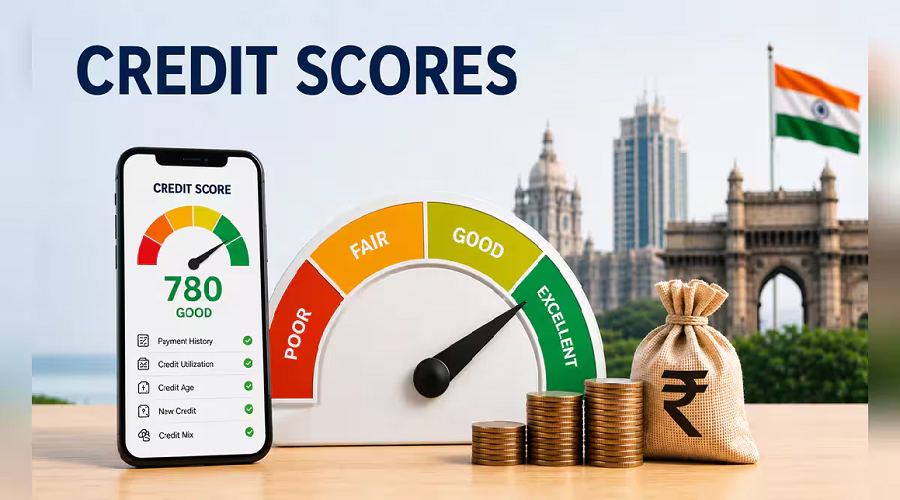
What Is a Credit Score? A credit score is a three-digit number, usually somewhere between 300 and 900, that tells lenders how likely you are to repay money you borrow. Think of it as a financial report card. Banks, NBFCs, and credit card companies look at it before deciding whether to trust you with a loan, and on what terms.
In India, this number is generated by four RBI-licensed credit bureaus: CIBIL (TransUnion CIBIL), Equifax India, Experian India, and CRIF High Mark. Each one uses your credit history, meaning how you’ve handled loans and credit cards in the past, to calculate a score. Most people in India refer to their “CIBIL score” the way people refer to tissues as “Kleenex.” It’s the most commonly checked one, but it isn’t the only one that exists.
Here’s the part most articles skip: if you’re reading this because you’ve never taken a loan or owned a credit card, you might not have a score at all yet, and that’s completely normal. We’ll get to that shortly.
One quick note before we go further. If you’ve read about credit scores on international websites, you may have seen a 300 to 850 range mentioned. That’s the US system (FICO). India’s CIBIL score runs from 300 to 900. Different country, different scale, so don’t compare the two directly.
Why Does a Credit Score Matter?
Let’s say Rahul, a 26 year old software developer in Bengaluru, applies for a personal loan to cover a family medical expense. His bank checks his CIBIL score before approving anything. If his score is 780, he likely gets approved quickly, possibly at a lower interest rate. If it’s 620, the bank might reject the application outright, or approve it at a much higher rate to offset the perceived risk.
That’s the real world impact of this number. A good score can save you lakhs of rupees in interest over the life of a home loan. A poor one can mean rejection, higher EMIs, or having to settle for a lender with stricter terms.
It goes beyond loans too. Some landlords in metro cities now check credit scores before renting out property. A few insurers factor it into premium calculations. And employers in finance heavy roles occasionally review it as part of background checks. Your score has quietly become a small but real part of how the world sees your financial reliability.
If you’re in your twenties and just starting out, here’s the honest truth: the earlier you understand this, the more control you have over your future EMIs, loan approvals, and interest rates.
What Is a Good Credit Score in India?
Lenders in India generally read the CIBIL score like this:
- 300 to 549: Poor. Getting approved for anything will be difficult without a co-applicant or collateral.
- 550 to 649: Fair. You may get approved, but expect higher interest rates and lower loan amounts.
- 650 to 749: Good. Most lenders will consider you, and terms start improving.
- 750 to 900: Excellent. This is the sweet spot most banks look for. You’ll get faster approvals, better interest rates, and higher credit limits.
Most Indian banks and NBFCs treat 750 as the practical cutoff for their best offers. If your score sits below that, it doesn’t mean you’re locked out of credit entirely, it just means you’ll likely pay more for it or need to work with a co-applicant.
Also worth remembering: your score can differ slightly across CIBIL, Equifax, Experian, and CRIF High Mark, because they don’t always receive identical data from every lender at the same time. Don’t panic if you check two of them and see a 10 to 15 point gap. That’s normal.
How Is a Credit Score Calculated?
This is one of the most searched questions on this topic, and for good reason. Credit bureaus don’t reveal their exact formulas, but the factors that go into the calculation are well known and broadly consistent across bureaus. For a deeper breakdown, BusinessMust has a full explainer on how credit score is calculated that walks through each factor in more detail.
- Payment history. This carries the most weight, often around 30 to 35 percent of your score. Every EMI, credit card bill, and loan repayment you’ve made or missed gets recorded. A single missed payment can dent your score more than you’d expect.
- Credit utilization ratio. This is how much of your available credit you’re actually using. If your credit card limit is ₹1,00,000 and you consistently carry a balance of ₹80,000, that 80 percent utilization signals risk to lenders, even if you eventually pay it off. Staying under 30 percent utilization is the general rule of thumb.
- Length of credit history. Older accounts help your score, because they show a longer track record. This is one reason financial advisors often say don’t close your oldest credit card, even if you rarely use it.
- Credit mix. Having a mix of secured loans (like a car or home loan) and unsecured credit (like a credit card or personal loan) shows lenders you can handle different types of credit responsibly.
- Hard inquiries. Every time you apply for a new loan or credit card, the lender runs a hard inquiry on your credit report, and that shows up. Applying for five credit cards in two months looks desperate to a lender, even if your intentions were harmless.
For someone building credit from zero, payment history and utilization matter the most in the first year or two. Get those two right and the rest tends to follow.
I Have No Credit History. Can I Even Get a Score?
This is probably the most common question we hear from people in their early twenties, and it’s rarely answered honestly on most websites.
If you’ve never taken a loan or owned a credit card, you’re what bureaus call “New to Credit” or NTC. You don’t have a bad score, you simply don’t have a score yet, because there’s no data to calculate one from. These are two very different situations, but they often get treated the same way in generic articles.
Here’s how people typically start from scratch in India:
Secured credit cards. Many banks let you open a credit card against a fixed deposit. Since it’s backed by your own money, approval is easy even with zero credit history, and using it responsibly starts building your file.
Becoming an add-on cardholder. If a parent or sibling has a credit card and adds you as an authorized user, their responsible repayment history can help establish your own credit profile over time.
Credit builder loans. Some NBFCs and fintech apps now offer small loans specifically designed to help first timers build a credit history, sometimes as small as ₹5,000 to ₹10,000, repaid over a few months.
Consumer durable loans. Taking a small EMI on a phone or laptop purchase and repaying it on time is another common starting point for young professionals.
Realistically, it takes about 4 to 6 months of activity before bureaus have enough data to generate your first score, and closer to a year of consistent, on time repayment before that score starts looking genuinely strong. There’s no shortcut here. Consistency is the entire game.
How to Check Credit Score Online in India
You’re entitled to one free full credit report per bureau, per year, under RBI guidelines. That means you can get four free reports annually if you check one from each bureau.
Beyond that, several apps and websites let you check your credit score online for free, often updated monthly, funded by their business model of recommending credit products. You can also check your score directly on the official CIBIL website. These give you a good running view of where you stand without any cost.
A common myth worth clearing up: checking your own score does not lower it. That’s called a soft inquiry, and it has zero impact on your credit health. It’s only hard inquiries, the ones triggered by actual loan or credit card applications, that can cause a small, temporary dip.
If you’ve never checked yours, do it this week. It takes about five minutes and it’s the single most useful thing you can do before applying for any kind of credit.
How to Build or Improve Your Credit Score
If you already have a score and want to move it in the right direction, here are some of the best ways to improve your CIBIL score that actually work:
- Pay every bill on time, every time. Set up autopay for at least the minimum due if you’re worried about forgetting. Payment history has the biggest single impact on your score.
- Keep your credit utilization under 30 percent. If you know you’ll cross that on one card, consider paying it down mid cycle instead of waiting for the statement date.
- Don’t apply for multiple loans or cards in a short window. Space out applications by at least a few months where possible.
- Keep old accounts open. Even a credit card you rarely use helps your credit history length and your overall utilization ratio, as long as there’s no annual fee eating into you.
- Review your report for errors periodically. More common than people realize, and we’ll cover exactly what to do about it next.
For someone in their mid twenties with a first job and first salary account, the fastest realistic path to a strong score is usually: one credit card, used lightly and paid in full every month, for about 12 to 18 months straight.
What If There’s an Error on Your Credit Report?
Errors happen more often than you’d think. A loan you fully repaid still showing as active, a payment marked late when it wasn’t, or even someone else’s account mistakenly appearing on your report due to a data mismatch.
If you spot one, here’s the process:
- Raise a dispute directly with the credit bureau (CIBIL, Equifax, Experian, or CRIF High Mark) through their online dispute portal.
- The bureau forwards your dispute to the lender who reported the information.
- The lender is required to investigate and respond, typically within 30 days.
- Once resolved, your report gets updated, and you’ll usually see the corrected score within a billing cycle or two.
This matters more than it might seem. An unresolved error sitting on your report right before you apply for a home loan can genuinely cost you a better interest rate, so it’s worth checking your report a few months before any major loan application, not the week before.
Credit Score FAQs
Does checking my own credit score lower it?
No. Checking your own score is a soft inquiry and has no effect on your score. Only hard inquiries from actual credit applications can cause a small, temporary dip.
How is a credit score different from a credit report?
Your credit report is the detailed document, a full history of your loans, credit cards, payments, and inquiries. Your credit score is the three digit summary number calculated from that report. Think of the report as the data and the score as the headline.
Does my income affect my credit score?
Not directly. Credit scores are based on borrowing and repayment behavior, not income. That said, lenders often look at income separately alongside your score when deciding how much to approve.
Can I get a loan with a low or no credit score?
Yes, though your options are more limited. Secured loans, loans against fixed deposits, or applying with a co-applicant who has a strong score are common paths when your own credit history is thin or your score is on the lower side.
How often does my credit score update?
Most lenders report data to bureaus monthly, so your score typically updates once a month, though the exact timing can vary by lender.
Ready to Take the Next Step?
Understanding your credit score is the easy part. Using it well is where the real advantage kicks in. If you’re planning to apply for credit soon, start by checking your score online, then explore what fits your situation next, whether that’s your first credit card, a personal loan, or comparing home loan rates before you commit to one. BusinessMust breaks down all of it in plain language, so you can make the decision with confidence instead of guesswork.
Disclaimer: This article is for general informational and educational purposes only and does not constitute financial, legal, or credit advice. Credit score ranges, calculation factors, and RBI guidelines mentioned here are based on publicly available information at the time of writing and may change. BusinessMust does not guarantee loan approval, credit card approval, or any specific credit score outcome. Please verify current details with your bank, NBFC, or the relevant credit bureau (CIBIL, Equifax India, Experian India, or CRIF High Mark) and consult a certified financial advisor before making any borrowing or credit related decisions.
