

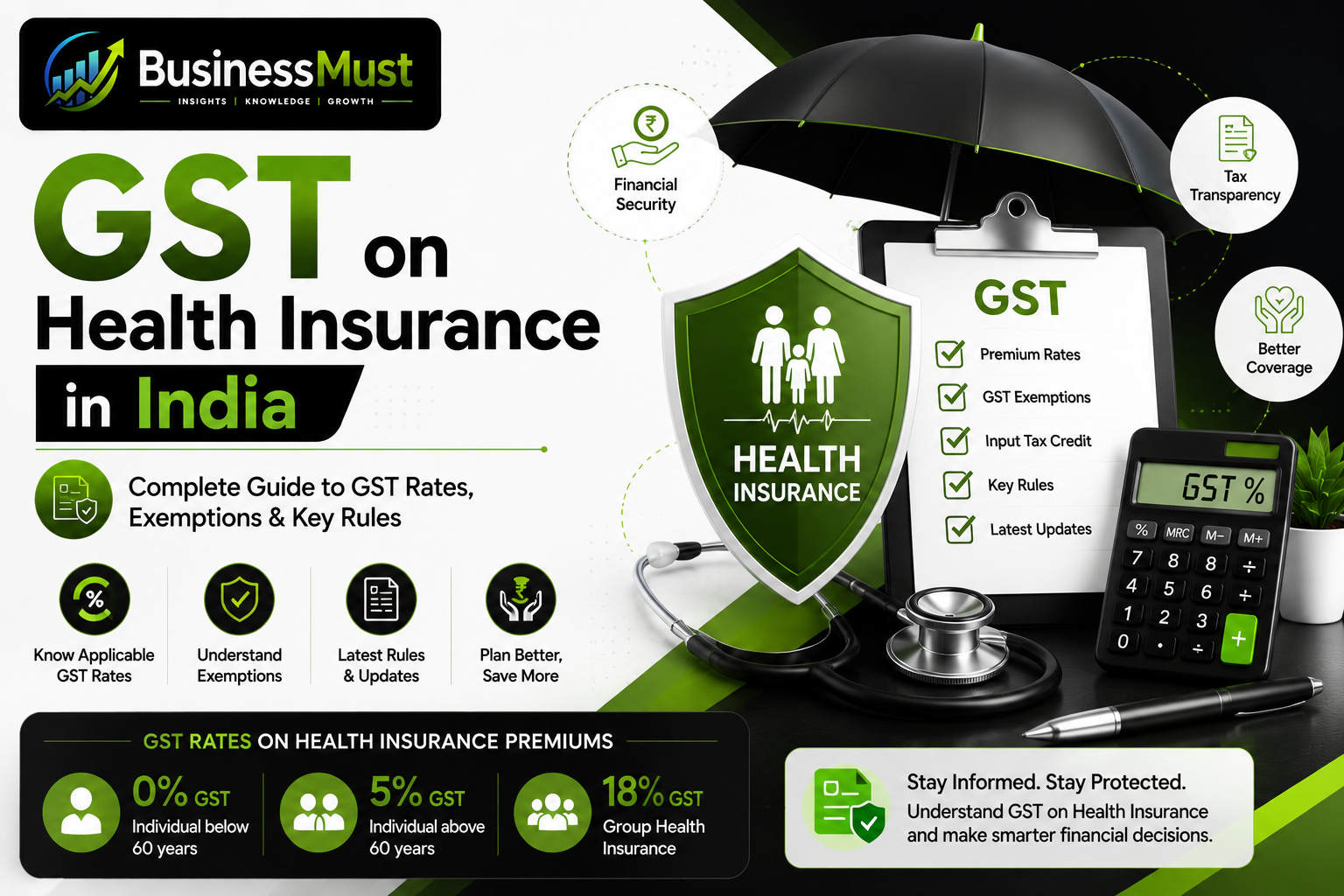
If you have bought or renewed a health insurance policy recently, you have probably noticed something different on your premium receipt. The GST line item that used to add a chunky 18% to your bill is gone, at least for most individual policies. But if you run a business and pay for group health cover for your team, you are still seeing that 18% show up. So what changed, what didn’t, and what does it actually mean for your wallet?
Let’s break it down properly, because the headlines (“GST on health insurance scrapped!”) only tell half the story.
What Is GST on Health Insurance?
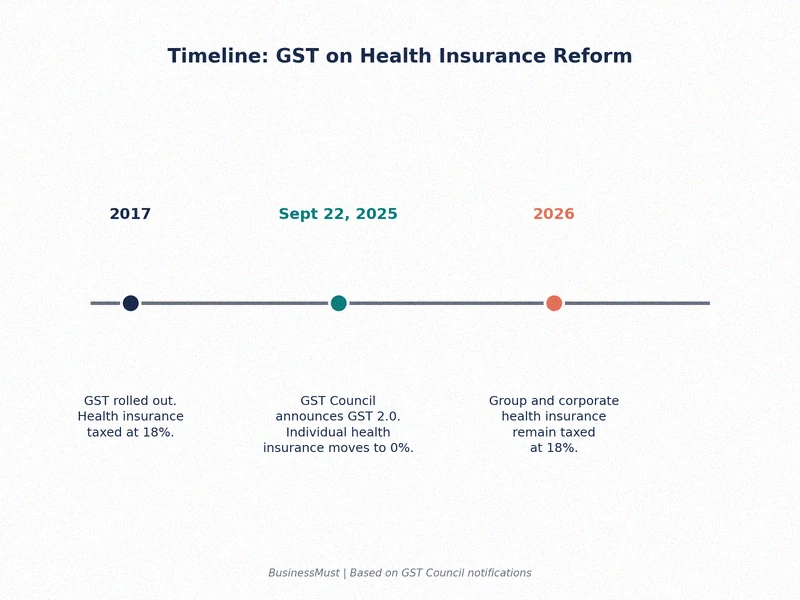
GST, or Goods and Services Tax, is charged on the service of providing insurance cover, not on the payout you receive if you make a claim. Every time you pay a premium, a part of that payment used to go to the government as tax. Since GST rolled out in July 2017, that rate had been a flat 18% on almost every health insurance premium in India.
That changed on September 22, 2025, when the GST Council announced its GST 2.0 reforms. Under these reforms, individual health insurance premiums, including family floater plans, moved from 18% to 0% GST. This is the single biggest update in this space in years, and it’s why so many people are searching for clarity right now.
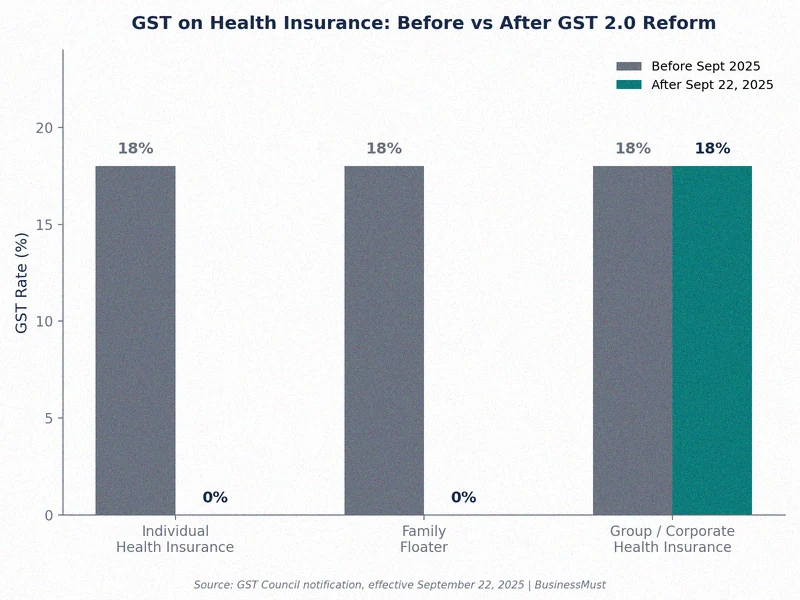
Here’s the part that trips people up: this 0% rate applies to individual and family floater health insurance. It does not apply to group or employer-sponsored health insurance, which is still taxed at 18%. If you are a salaried employee covered only under your company’s group policy, this reform doesn’t touch your situation at all.
Current GST Rates on Health Insurance (2026)
Here’s where things stand right now, plan by plan:
| Policy Type | Old GST Rate | Current GST Rate |
|---|---|---|
| Individual health insurance | 18% | 0% |
| Family floater plans | 18% | 0% |
| Senior citizen health plans | 18% | 0% |
| Top-up and super top-up plans | 18% | 0% |
| Group/corporate health insurance | 18% | 18% |
Where the 18% still applies, it’s split as 9% CGST (Central GST) and 9% SGST (State GST) for transactions within the same state, or 18% IGST for transactions across states. This split doesn’t change your total bill, it just determines which government the tax revenue goes to. Most individual buyers don’t need to worry about this detail, but if you’re a CA or tax consultant reading this for a client, it’s a standard destination-based GST structure, nothing unusual for insurance as a service.
Why Was GST Removed on Individual Health Insurance?
The GST Council’s stated reasoning was straightforward: make health insurance more affordable and push up insurance penetration in India, which currently sits at around 4%, well below the global average of roughly 7%. Rising healthcare costs have been outpacing income growth for years, and a lot of families were either underinsured or skipping cover altogether because premiums felt too expensive.
Removing the tax was meant to nudge more people toward buying cover, especially first-time buyers and families who had been putting it off. Industry voices largely welcomed the move, calling it a step toward closing the protection gap. That’s the official story, and it’s a reasonable one. But the real question for your wallet is whether the saving actually shows up in full, which brings us to the next section.
How Much Will You Actually Save?
Let’s use real numbers. Say you’re paying ₹20,000 a year for an individual health insurance policy.
| Before Sept 2025 | After Sept 22, 2025 | |
|---|---|---|
| Base premium | ₹20,000 | ₹20,000 |
| GST (18% / 0%) | ₹3,600 | ₹0 |
| Total you pay | ₹23,600 | ₹20,000 |
| Annual saving | ₹3,600 |
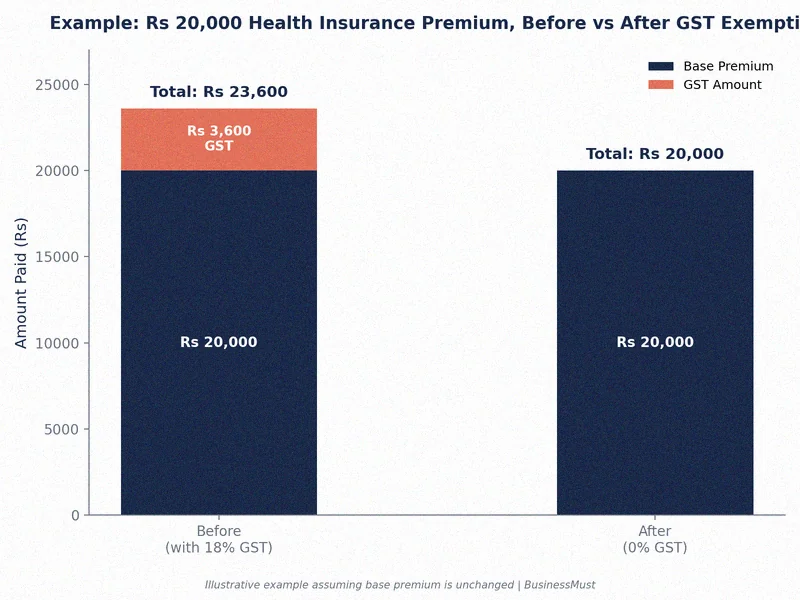
That’s a straight saving of ₹3,600 a year, which is meaningful money for most households. Here’s how that scales at different premium levels:
| Annual Premium (Base) | GST at 18% (Old) | Total Before | Total After (0% GST) | Annual Saving |
|---|---|---|---|---|
| ₹10,000 | ₹1,800 | ₹11,800 | ₹10,000 | ₹1,800 |
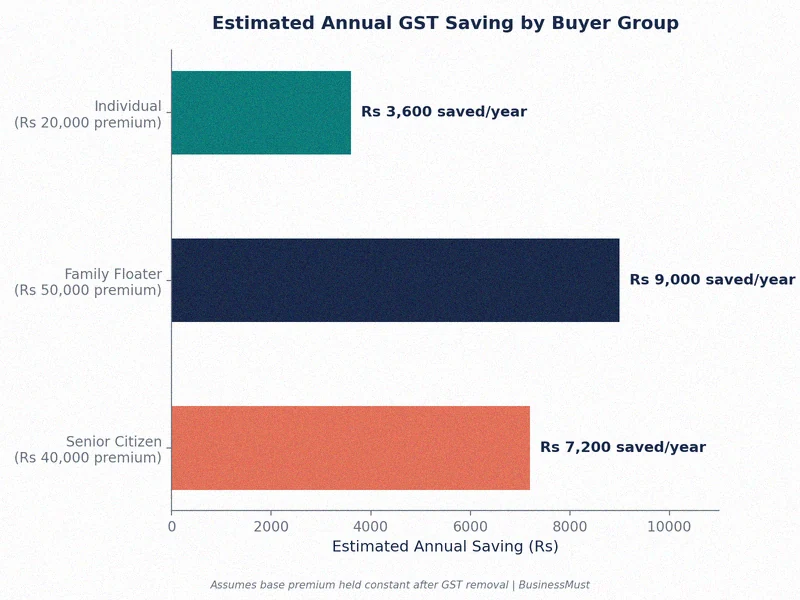
| ₹20,000 | ₹3,600 | ₹23,600 | ₹20,000 | ₹3,600 |
| ₹35,000 | ₹6,300 | ₹41,300 | ₹35,000 | ₹6,300 |
| ₹50,000 | ₹9,000 | ₹59,000 | ₹50,000 | ₹9,000 |
On paper, this looks like a clean win across every premium band.
Here’s the catch nobody talks about enough. Insurers used to claim Input Tax Credit (ITC) on the GST they paid for their own business expenses, like reinsurance costs, IT systems, and commissions to agents, and offset it against the GST they collected from you. Now that individual health insurance is GST-exempt, insurers can no longer claim that ITC. That’s a real cost increase on their side.
What this means practically: some insurers may quietly raise the base premium to recover that lost ITC, even though the GST line disappears. So your total bill might not drop by the full 18% you’re expecting. It might drop by 12%, or 15%, or even less, depending on how much of that ITC loss the insurer decides to pass through to you versus absorb.
The honest advice here is simple. Don’t just look at the headline “0% GST” and assume you’re automatically paying 18% less than before. Pull up your actual renewal premium and compare it line by line against last year’s invoice. If the base premium has crept up, that’s your answer. This is the single most useful check you can do before renewing, and it takes two minutes.
GST on Group Health Insurance (For Employers & SMB Owners)
If you run a small business and provide group health cover for your employees, here’s what you need to know: nothing has changed for you. Group and corporate health insurance premiums are still taxed at 18%, exactly as before. The GST 2.0 reforms specifically carved out individual and family floater policies, and group cover was left untouched.
This matters for your budgeting. If you were hoping the reform would trim your company’s health insurance spend for staff, it won’t. Your HR or finance team should plan renewals assuming the same 18% GST load as last year.
There is one silver lining for businesses, though. Employers can claim Input Tax Credit on GST paid for group health insurance premiums, where the cover is used for taxable business purposes, such as statutory employee welfare obligations. This ITC claim reduces your company’s overall GST liability, which is a real, usable benefit that individual policyholders simply don’t have access to. If your business isn’t currently claiming this ITC, it’s worth a conversation with your accountant, because it directly lowers your effective insurance cost.
One more point worth flagging to your team or employees: if someone on your staff is confused about why their personal health policy shows 0% GST while the company’s group cover still shows 18%, now you know exactly how to explain it. It’s not a billing error, it’s just how the reform was structured.
GST and Section 80D Tax Deductions: Do They Interact?
This is a question a lot of salaried employees and their CAs are asking right now, so let’s clear it up directly.
Section 80D lets you claim a tax deduction on the health insurance premium you actually pay, up to ₹25,000 for yourself and family, and up to ₹50,000 for senior citizen parents. The deduction is based on the total amount paid, whatever that number happens to be.
| Category | Maximum 80D Deduction Limit |
|---|---|
| Self, spouse, and dependent children (below 60) | ₹25,000 |
| Self and family, where you are a senior citizen (60+) | ₹50,000 |
| Parents below 60 (additional, on top of self/family limit) | ₹25,000 |
| Parents who are senior citizens (additional) | ₹50,000 |
| Maximum combined deduction (self below 60 + senior citizen parents) | ₹75,000 |
Since your premium is now lower (no GST added), your 80D deduction claim will naturally be a slightly smaller number too, because you’re paying less overall. But the deduction mechanism itself, the eligibility, the limits, and how you claim it, hasn’t changed at all. There’s no separate GST-related clause in Section 80D that affects your eligibility.
Practical example: if you were paying ₹23,600 (including GST) and claiming that full amount under 80D last year, this year you’ll pay ₹20,000 with no GST, and you claim ₹20,000 instead. Your tax saving as a percentage of your income drops slightly, simply because your total spend dropped. That’s it. No hidden complication here, despite how often this question gets asked.
What Happens to Policies Purchased Before the Exemption?
If you bought or renewed your policy before September 22, 2025, you paid the full 18% GST at that time, and that transaction stands as it was. There’s no automatic refund mechanism for premiums already paid under the old rate, since the exemption applies from the effective date forward, not retroactively.
Where it gets slightly more nuanced is for policies that were in the process of being issued right around the transition date, or for annual policies renewing shortly after September 22, 2025. In these cases, insurers adjusted their billing systems to apply 0% GST from the effective date onward. If your renewal date fell right after the cutoff and you were still charged 18%, that’s worth flagging to your insurer directly, since it may be a billing system lag rather than an intentional charge.
If you’re an insurance advisor or agent reading this, this transition window is a good thing to walk your clients through proactively, since a lot of confusion in this space traces back to timing rather than actual policy terms.
Quick reference for the key dates:
| Date | What Happened |
|---|---|
| July 2017 | GST rolled out. Health insurance premiums taxed at 18% across the board. |
| September 22, 2025 | GST Council’s GST 2.0 reform takes effect. Individual and family floater health insurance moves to 0% GST. |
| Policies renewed after Sept 22, 2025 | Billed at 0% GST for individual/family floater plans, 18% continues for group cover. |
| Policies paid before Sept 22, 2025 | No retroactive refund. That transaction remains at the 18% rate that applied at the time. |
Impact on Different Buyer Groups
Not everyone experiences this reform the same way, so here’s a quick breakdown by who you are:
First-time buyers: This is genuinely good news. A lower entry cost makes it easier to justify buying a policy you’d been putting off. Use this as your nudge to finally get covered, especially if you’ve been sitting on the fence because of cost.
Senior citizens: Senior citizen health plans typically carry higher premiums due to age-related risk, so the rupee saving here is larger in absolute terms. On a ₹40,000 senior citizen premium, that’s roughly ₹7,200 saved a year, assuming the base premium doesn’t rise to offset it.
Families comparing plans: When comparing Health Insurance Plans for Family across insurers, make sure you’re comparing GST-inclusive totals from before the reform against GST-exempt totals now, rather than accidentally comparing an old quote to a new one and assuming you’re seeing a fair like-for-like difference.
Self-employed and business owners: If you’re claiming your personal health insurance premium as a business expense (where applicable under your business structure), the lower premium simply means a smaller expense claim, similar to the 80D situation above. It doesn’t change how the expense is treated.
Salaried employees on group cover only: As covered above, this reform doesn’t touch your situation unless you also hold a separate individual policy.
Here’s the same breakdown in one place for quick reference:
| Buyer Group | GST Impact | Estimated Annual Saving |
|---|---|---|
| First-time buyers | Full 0% exemption applies | Lower entry cost, varies by premium |
| Senior citizens (₹40,000 premium example) | Full 0% exemption applies | ~₹7,200/year |
| Families comparing plans (₹50,000 premium example) | Full 0% exemption applies | ~₹9,000/year |
| Self-employed / business owners (personal policy) | Full 0% exemption applies | Same as individual, smaller expense/80D claim |
| Salaried employees on group cover only | No change, still 18% GST | None |
FAQs
Is GST really 0% on all health insurance now?
No. It’s 0% specifically on individual and family floater health insurance policies, effective September 22, 2025. Group and corporate health insurance is still taxed at 18%.
Does GST apply to top-up and super top-up plans?
No, top-up and super top-up plans bought as individual policies fall under the same 0% exemption as regular individual health insurance.
Is GST charged on health insurance claims or payouts?
No. GST is only charged on the premium you pay to buy or renew a policy. Claim settlements, whether for hospitalisation, treatment reimbursement, or any other payout, are not subject to GST at all.
Can businesses claim Input Tax Credit on employee health insurance?
Yes, for group health insurance premiums used for taxable business purposes, employers can generally claim ITC on the GST paid, which reduces the company’s overall GST liability. Individual policies don’t offer any ITC benefit since they’re exempt.
Will my premium definitely be 18% cheaper at renewal?
Not necessarily the full 18%. While the GST component itself drops to zero, some insurers may adjust base premiums upward to offset their own lost Input Tax Credit. Always compare your actual renewal invoice against last year’s, line by line, rather than assuming a flat 18% drop.
Does this change affect my Section 80D tax deduction?
Not the mechanism itself. Your 80D deduction is based on the premium you actually pay, so a lower premium simply means a proportionally smaller deduction claim. The eligibility rules and limits under 80D remain unchanged.
Health insurance par GST abhi kitna hai?
Individual aur family floater health insurance policies par September 22, 2025 se GST 0% hai. Lekin agar aap company ke through group health insurance le rahe hain, to usme abhi bhi 18% GST lagta hai, koi change nahi hua hai usme.
GST hatne se premium kitna kam hoga?
Agar aapka premium Rs 20,000 tha, to pehle Rs 3,600 GST milakar total Rs 23,600 pay karte the. Ab GST 0% hone ke baad sirf Rs 20,000 dena hai, matlab seedha Rs 3,600 ka saving. Lekin ek baat dhyan rakhein, kuch insurance companies apna base premium thoda badha sakti hain, kyunki unko ab Input Tax Credit (ITC) nahi milega. Isliye renewal invoice ko last saal wale se compare zaroor karein.
Kya senior citizen policies par bhi GST exemption milega?
Haan, senior citizen health insurance plans bhi individual policy category me aate hain, isliye unpar bhi 0% GST lagu hota hai. Senior citizens ke liye ye khaas fayda hai kyunki unka premium already zyada hota hai, to saving bhi zyada milti hai.
Agar main apni family ke liye policy le raha hoon, to kya check karna chahiye?
Family floater plan lete waqt, GST-inclusive purana quote aur GST-exempt naya quote ko sahi tarike se compare karein. Aap hamara Health Insurance Plans for Family guide bhi dekh sakte hain, jisme family plans ki detailed comparison di gayi hai.
Kya ye GST exemption 80D tax deduction ko affect karta hai?
Nahi, 80D deduction ka rule same hai, jitna premium actually pay karte hain utna hi claim hota hai. Bas ab premium kam hai to deduction amount bhi thoda kam hoga, lekin deduction lene ka process bilkul waisa hi hai jaisa pehle tha.
Business owners ke liye kya alag hai?
Agar aap apne employees ke liye group health insurance le rahe hain, to us par 18% GST continue rahega, is reform ka usme koi asar nahi hai. Lekin business, ITC claim kar sakta hai group health insurance ke GST par, jo individual policyholders ke liye possible nahi hai.
At BusinessMust, we track these regulatory shifts as they happen and update our guides as new GST Council decisions come through, so you’re always working with the current picture rather than outdated numbers.
