

Your rent is due in three days. Your salary lands on the 1st. It’s the 25th. You’ve been in this exact spot before, staring at your bank balance, wondering if there’s a faster way out than asking a colleague for a loan you’ll feel awkward about for weeks. That’s exactly why “7 Days Loan App List” is one of the most searched phrases in Indian personal finance right now. And it’s also why most of the articles answering that search are pretty useless. They give you a list of app names, a few generic bullet points about speed and convenience, and send you off to download something without telling you what it’ll actually cost or how to tell a genuine lender from a risky one.
We’re doing this differently. At BusinessMust, we’ve dug into the actual interest rates, fees, and RBI rules behind these apps so you can borrow with your eyes open, not just your thumb on the download button.
What Is a 7 Days Loan App List and How Does It Actually Work?
A 7-day loan app is a digital lending platform that gives you a small, unsecured loan with a repayment window of roughly one to two weeks instead of the usual months-long EMI schedule. You apply from your phone, get approved (often within minutes), and repay the entire amount, principal plus interest plus fees, in one shot on the due date.
These apps generally fall into three categories, and the difference matters more than people realize:
Direct NBFC lenders. The app itself is owned by, or directly tied to, a Non-Banking Financial Company registered with the RBI. KreditBee (via Krazybee/Finnovation) and mPokket (via mPokket Financial Services) are examples. You’re borrowing directly from them.
Bank-backed lending apps. Backed by a scheduled bank or a bank’s NBFC arm, usually with slightly stricter eligibility but stronger regulatory oversight.
Loan aggregators or marketplaces. These apps don’t lend their own money. They match you with a partner NBFC or bank based on your profile. Your actual loan agreement is with that partner, not the app you downloaded. This matters when something goes wrong and you need to know who to complain to.
The typical flow looks like this: you complete KYC using Aadhaar and PAN, the app pulls your bank statement or checks your income and transaction history, you get an approved amount and rate, you accept the Key Fact Statement, and the money lands in your account, often the same day.
The Real Cost of a 7-Day Loan (With an Actual Example)
Here’s what almost nobody tells you clearly: a “low interest rate” on a 7-day loan can still be brutally expensive once you factor in processing fees and GST, because those flat charges get squeezed into a tiny repayment window.
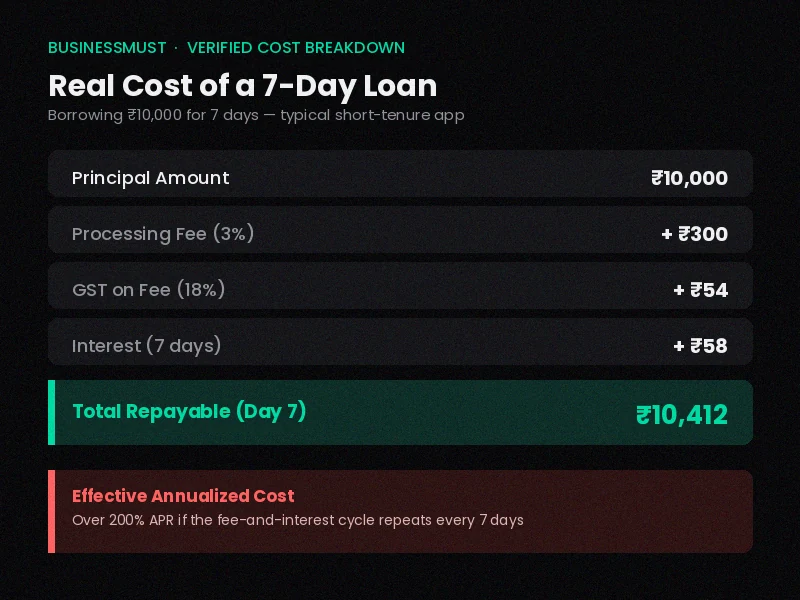
Let’s run real numbers. Say you borrow ₹10,000 for 7 days from a typical short-tenure lending app.
- Processing fee: 3% of loan amount = ₹300
- GST on processing fee (18%): ₹54
- Interest for 7 days at a monthly-equivalent rate of around 2.5%: roughly ₹58 (2.5% ÷ 30 days × 7 days × ₹10,000)
- Total repayable amount: approximately ₹10,412
- Total cost to you: ₹412 for a 7-day loan
That ₹412 sounds small in isolation. But annualize it and you’re looking at an effective rate well above 200% APR, because that same cost structure repeats every 7 days if you were to keep rolling the loan. This is the exact trap regulators have flagged with short-tenure digital lending: the headline rate looks reasonable, the real annualized cost does not.
Compare that to a slightly longer-tenure personal loan app like Fibe, where processing fees start around 2 to 3% and interest starts from roughly 16% per annum on longer tenures. The per-day cost drops significantly once you’re not squeezing fixed fees into a single week.
The takeaway: always ask for the total repayable amount in rupees, not just the interest rate percentage, before you accept any 7-day loan offer. If the app’s Key Fact Statement doesn’t show this clearly, that’s a red flag on its own.
Verified 7-Day and Short-Tenure Loan Apps in India (2026)
Below is a comparison based on publicly available lender data as of mid-2026. Rates and fees change based on your credit profile, so treat these as ranges, not guarantees.
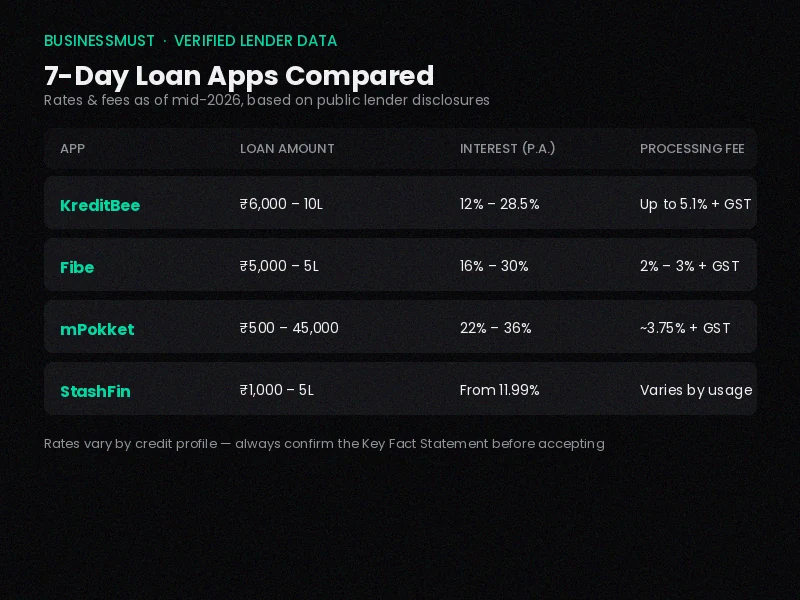
| App | Lender Type | Loan Amount | Interest Rate (p.a.) | Processing Fee | Best For |
|---|---|---|---|---|---|
| KreditBee | Direct NBFC (Finnovation Tech Solutions) | ₹6,000 to ₹10,00,000 | 12% to 28.5% | Up to 5.1% + GST | Salaried and self-employed needing flexible amounts |
| Fibe (formerly EarlySalary) | Direct NBFC | ₹5,000 to ₹5,00,000 | 16% to 30% | 2% to 3% + GST | Salaried professionals, zero foreclosure charge |
| mPokket | Direct NBFC (mPokket Financial Services) | ₹500 to ₹45,000 | 22% to 36% (roughly 1.5% to 3% monthly) | Around 3.75% + GST | Students and first-time borrowers with thin credit history |
| StashFin | Direct NBFC-backed credit line | ₹1,000 to ₹5,00,000 | Starting around 11.99% | Varies by credit line usage | Users who want a reusable credit line instead of one-time loans |
| Kissht | NBFC partner lending | Varies by partner | Varies by partner | Varies by partner | Point-of-sale and short-term personal borrowing |
Best fit by who you are:
- Salaried employees with a stable monthly income and an existing credit history will usually get better rates from Fibe or KreditBee, since both weigh salary slips and bank statements heavily.
- College students and first-time borrowers with little or no CIBIL history tend to have more luck with mPokket, which was built specifically for this segment and doesn’t demand a strong credit score.
- Gig workers and freelancers should look for apps that explicitly accept bank transaction history or platform earnings as proof of income instead of a formal salary slip. Read the eligibility page carefully before applying, since many apps still default to salaried-only criteria.
- Small business owners needing short-term working capital are usually better served by a business-specific short-term loan product than a personal 7-day app, since ticket sizes and repayment flexibility differ.
A quick note on freshness: loan apps get delisted from the Play Store fairly often when RBI flags irregular practices. Before you download any app from this or any list, search for it directly in the Play Store or App Store and confirm it’s still live and being actively updated.
How to Check If a 7-Day Loan App Is Actually Legitimate
This is the step most people skip, and it’s the one that protects you the most.
Under RBI’s Digital Lending Guidelines, every legitimate lending app is required to meet a specific set of disclosure and conduct standards. Here’s your 60-second checklist before you hand over your Aadhaar and bank details to any app:
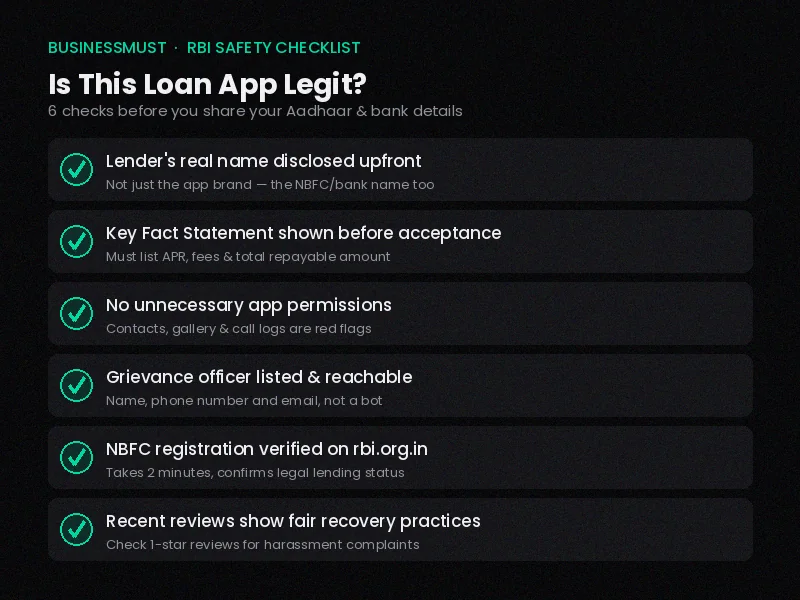
- The lender’s actual name is disclosed upfront, not just the app’s brand name. If you can’t find the name of the NBFC or bank behind the app within the first screen or two, that’s a warning sign.
- You’re shown a Key Fact Statement (KFS) before you accept the loan. This document must clearly state the annual percentage rate, all fees, and the total repayable amount.
- The app doesn’t ask for unnecessary permissions. A loan app has no legitimate reason to access your contacts, photo gallery, or call logs. If it does, and won’t let you proceed without granting that access, walk away.
- There’s a listed grievance redressal officer with a name, phone number, and email you can actually reach.
- You can verify NBFC registration on the RBI’s website (rbi.org.in) under the list of registered NBFCs. This takes two minutes and confirms the entity is legally allowed to lend.
- Recent reviews mention fair recovery practices. Skim the most recent 1-star Play Store reviews specifically. Repeated complaints about harassment, contacting family members, or threats are a serious red flag, regardless of how fast the app claims to disburse money.
If an app fails even one or two of these checks, it’s worth pausing before you proceed, no matter how urgent your cash need feels in the moment.
Eligibility Criteria: What These Apps Actually Look At
Every app has its own scoring model, but most short-tenure lenders evaluate you across a similar set of factors.
Age and residency. Most require you to be at least 18 to 21 years old and a resident Indian citizen.
Minimum income. This varies widely. Fibe generally expects a minimum salary of ₹15,000 to ₹25,000 depending on your city, while apps built for students and gig workers, like mPokket, often skip a hard income floor and rely on other signals instead.
Bank account activity. Even without a strong CIBIL score, your bank statement tells lenders a lot: how regularly money comes in, whether you bounce payments, and how you handle existing obligations.
Alternative data for thin-file borrowers. If you’re a student, freelancer, or gig worker without a long credit history, apps increasingly look at things like your UPI transaction pattern, employer or platform reputation, and repayment behavior on any prior small loans you’ve taken through the same app.
For small business owners, working capital-focused short loans typically ask for GST returns or business bank statements instead of a personal salary slip, since the underlying risk assessment is different.
What Happens If You Miss the 7-Day Repayment Deadline?
This is the part that catches people off guard, mostly because nobody explains it clearly before they borrow.
Because the repayment window is so short, penalties on 7-day loans accumulate fast relative to the loan size. A missed payment typically triggers, in order:
- A short grace period, if the lender offers one at all. Many 7-day products don’t.
- Daily or flat late fees, which can range from a fixed penalty amount to a percentage of the overdue sum per day.
- Collection calls and reminders, increasing in frequency the longer the amount stays unpaid.
- Credit bureau reporting. Most regulated NBFCs report repayment behavior to CIBIL or Experian. A default on even a small short-term loan can dent your credit score and hurt your ability to get approved for larger loans later.
The single biggest mistake people make here is borrowing from a second app to repay the first. It feels like a quick fix but it just stacks debt on debt, and lenders can see multiple recent loan applications on your credit report, which itself lowers your approval odds going forward.
If you know you’re going to miss a deadline, contact the lender before the due date, not after. Many NBFCs offer a short extension or partial payment option if you reach out proactively. Silence is what turns a manageable situation into a genuinely damaging one.
7-Day Loan Alternatives Worth Considering First
Before you commit to a short-tenure loan, it’s worth checking whether a cheaper option is sitting right in front of you.
Employer salary advance. Many companies, especially larger ones, offer a salary advance facility through HR or payroll. It’s usually interest-free or close to it, and it doesn’t touch your credit score at all.
Credit card cash withdrawal or short-term BNPL. If you already hold a credit card, compare its cash advance rate and fees against a 7-day loan app’s total cost. Some 0% BNPL options on specific platforms can also be cheaper for a genuine one-time expense, though they’re not designed for cash-in-hand needs.
UPI-linked small credit lines from your bank. A handful of banks now offer instant, small-ticket credit lines directly through UPI apps, often at lower effective rates than app-based NBFC lenders, particularly if you already have an existing relationship with that bank.
A 7-day loan genuinely makes sense for a one-off emergency you can clearly repay on the due date, a medical bill, a broken appliance, an unexpected travel need. It becomes a problem the moment it turns into a recurring monthly patch for a budget shortfall, because the fee structure that felt small once starts compounding every time you renew it.
How to Apply for a 7-Day Loan App: Step by Step
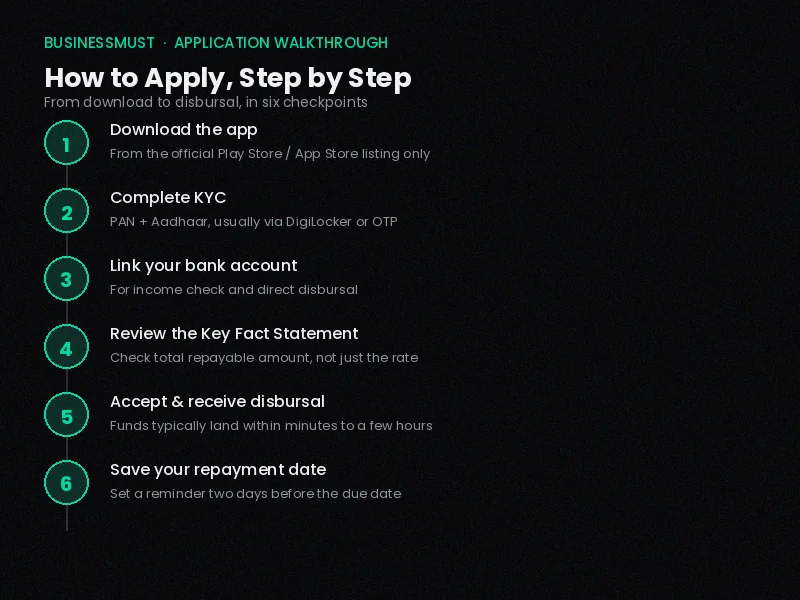
- Download the app from the official Play Store or App Store listing, and confirm it’s still active and recently updated.
- Complete KYC using your PAN and Aadhaar. Most apps do this through DigiLocker or an OTP-based verification.
- Link your bank account so the lender can assess your income and repayment capacity, and so the loan can be disbursed directly.
- Review the Key Fact Statement carefully before accepting. Check the total repayable amount, not just the headline rate.
- Accept the terms and receive disbursal, usually within minutes to a few hours for approved applications.
- Screenshot or save your repayment date and total amount due. Set a reminder two days before the deadline, not on the day itself.
FAQs
Can I get a 7-day loan without a CIBIL score?
Yes. Several apps, mPokket in particular, are built for first-time borrowers with no credit history and rely on alternative data like bank transactions and income patterns instead of a CIBIL score.
Which 7-day loan apps are RBI-approved?
No app is “RBI-approved” in the sense of official endorsement. What you should check instead is whether the NBFC behind the app is RBI-registered, which you can verify directly on the RBI website. KreditBee, Fibe, and mPokket all operate through RBI-registered NBFC entities.
What is the maximum amount I can borrow for 7 days?
This depends heavily on the app and your profile, but most short-tenure products cap first-time borrowers well below their overall lending limit, often between ₹3,000 and ₹20,000, with higher limits unlocked after a repayment track record.
Can students or freelancers apply for a 7-day loan?
Yes, but eligibility varies by app. Student-focused apps like mPokket accept applicants with limited income proof, while apps built primarily for salaried employees may reject freelancers without a formal payslip.
Is it safe to share Aadhaar and PAN with these apps?
It’s safe with RBI-registered lenders that follow proper KYC protocol and don’t request unnecessary permissions like contact or gallery access. Always verify the app’s legitimacy checklist before submitting your documents.
How does a 7-day loan affect my CIBIL score?
Timely repayment can help build a thin credit file over time, since many NBFCs report to credit bureaus. Missed or late repayment, on the other hand, can lower your score even for a small loan amount.
What’s the difference between a 7-day loan app and a regular personal loan app?
A 7-day loan is a short-tenure product with a lump-sum repayment, usually smaller in size and higher in effective annualized cost. A regular personal loan spreads repayment across months or years with an EMI structure, which generally works out cheaper for larger amounts.
7 din wale loan app mein kitna paisa mil sakta hai?
Zyada tar apps first-time users ko ₹3,000 se ₹20,000 tak ka loan dete hain. Jaise jaise aap time pe repay karte ho, limit dheere dheere badhti jaati hai.
Bina CIBIL score ke 7 days loan app se loan mil sakta hai kya?
Haan, bilkul mil sakta hai. mPokket jaise apps khaas taur pe un logon ke liye bane hain jinka CIBIL score nahi hai ya credit history bahut kam hai. Ye apps bank statement aur income pattern dekh kar decide karte hain.
Agar time pe repay nahi kiya toh kya hoga?
Late fee lagna shuru ho jaata hai, aur kuch din baad recovery calls aane lagte hain. Sabse important baat, aapka repayment behaviour CIBIL ko report ho sakta hai, jisse aapka credit score gir sakta hai. Isliye due date se pehle hi lender se baat kar lena behtar hota hai agar payment mein dikkat ho rahi ho.
Kaunsa 7 days loan app sabse safe hai?
Koi bhi ek app “sabse safe” nahi hota, ye depend karta hai ki uske peeche RBI-registered NBFC hai ya nahi. Apply karne se pehle RBI ki website pe lender ka naam check kar lena sabse safe tarika hai.
Final Verdict: Should You Take a 7-Day Loan?
A 7-day loan app can genuinely help when you’re dealing with a short, specific cash gap and you’re confident you can repay on the due date. It’s fast, it’s mostly paperless, and for the right situation, it does exactly what it promises.
Where it goes wrong is when people treat it as a recurring solution to a budget that doesn’t balance month to month, or when they skip the basic legitimacy checks because the money is needed urgently. Run the actual numbers before you borrow. Verify the lender. Know exactly what you owe and when.
If you’re still weighing your options, it’s worth comparing a 7-day loan against a slightly longer personal loan tenure or a salary advance first, since the total cost difference can be significant even for the same amount borrowed.
Disclaimer: This article is for general informational purposes only and does not constitute financial advice. Interest rates, processing fees, loan amounts, and eligibility criteria mentioned above are based on publicly available data at the time of writing and are subject to change at the lender’s discretion. BusinessMust does not endorse any specific loan app or lender and is not responsible for any loss or damage arising from decisions made based on this content. Please read the lender’s official terms, Key Fact Statement, and RBI registration details carefully before applying for any loan.
