

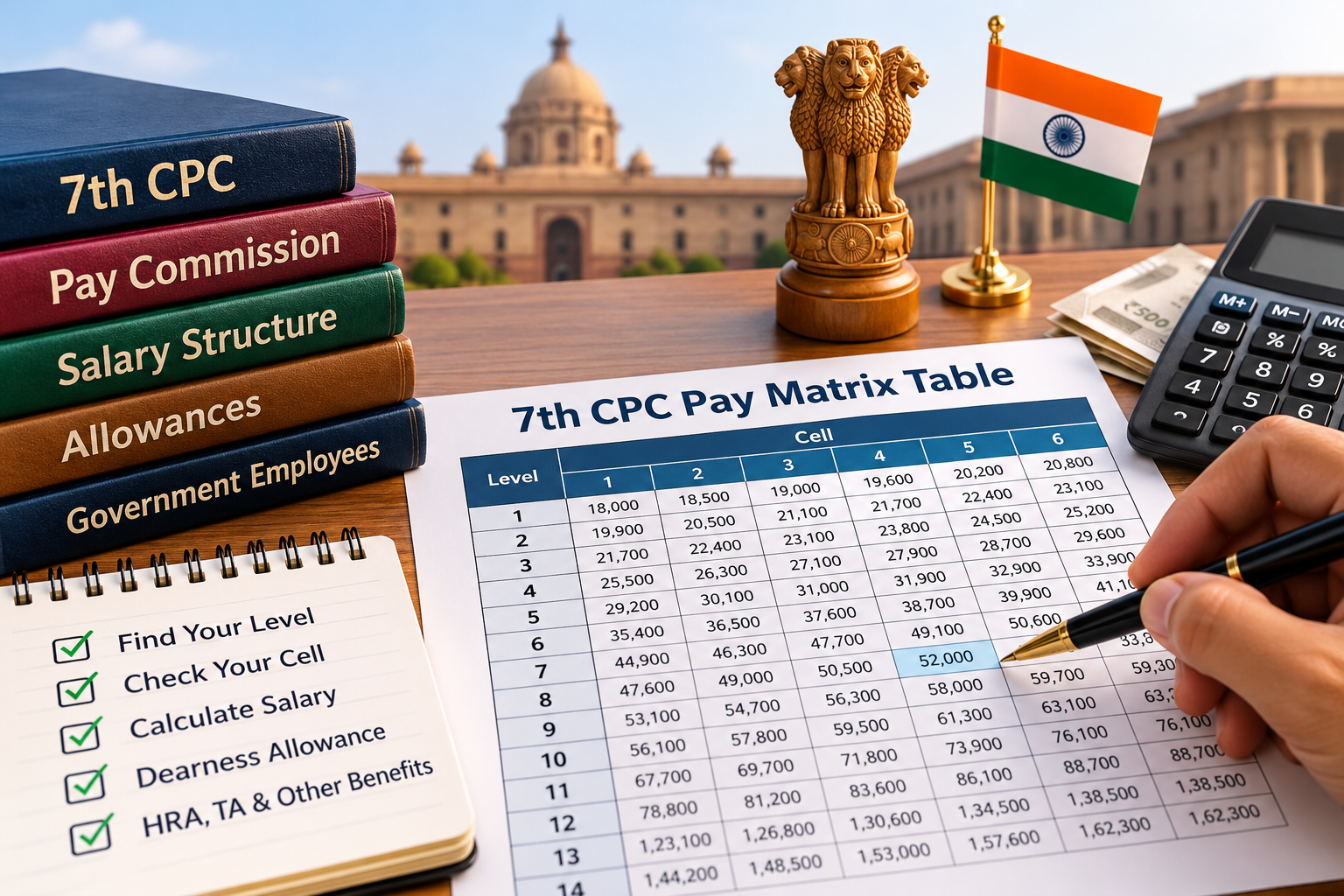
A new railway trackman, a Kendriya Vidyalaya teacher with five increments behind her, and a section officer who retired last year all read the same pay matrix table, yet each one needs a different answer from it. The trackman wants his starting salary, the teacher wants her next increment, and the pensioner wants to know how his last cell decides his pension. This BusinessMust guide shows you how to read the grid for your own situation, check any figure yourself, and see what the 8th Pay Commission could change.
Jump to your section: Full table · In-hand salary · Promotion and MACP · Defence, Railways, Teachers, Pensioners · State employees · 8th CPC
Table of Contents
ToggleWhat a Pay Matrix Actually Is (and What Replaced Grade Pay)
A pay matrix is a grid. Columns are pay levels and rows are cells (also called the index). The figure where your level and cell meet is your basic pay, and almost every allowance is calculated on it.
Before the 7th Pay Commission, salary was shown as Pay Band + Grade Pay, for example “PB-2, ₹9,300 to ₹34,800 with GP ₹4,200”. The 7th CPC replaced that with fixed levels, and each old grade pay became one level. So GP ₹4,200 became Level 6, GP ₹4,600 became Level 7, and so on. The matrix applies to central government employees from 1 January 2016.
The practical benefit: your exact basic pay for any year of service is printed in one place. You no longer need to calculate it from a band.
Pay Matrix Table for All Levels (1 to 18 and 13A)
Start with the summary below. It shows where each level begins, where it ends, and which posts usually sit there.
| Level | Old Grade Pay | Entry basic pay | Last cell | Cells | Example posts |
|---|---|---|---|---|---|
| 1 | ₹1,800 | ₹18,000 | ₹56,900 | 40 | MTS, Railway Group D |
| 2 | ₹1,900 | ₹19,900 | ₹63,200 | 40 | LDC, Assistant Loco Pilot |
| 3 | ₹2,000 | ₹21,700 | ₹69,100 | 40 | Constable, Postman |
| 4 | ₹2,400 | ₹25,500 | ₹81,100 | 40 | Tax Assistant, UDC |
| 5 | ₹2,800 | ₹29,200 | ₹92,300 | 40 | Auditor, Accountant |
| 6 | ₹4,200 | ₹35,400 | ₹1,12,400 | 40 | Junior Engineer, KVS PRT |
| 7 | ₹4,600 | ₹44,900 | ₹1,42,400 | 40 | ASO, Inspector, KVS TGT |
| 8 | ₹4,800 | ₹47,600 | ₹1,51,100 | 40 | Section Officer, KVS PGT |
| 9 | ₹5,400 (PB-2) | ₹53,100 | ₹1,67,800 | 40 | Group B posts with GP ₹5,400 |
| 10 | ₹5,400 (PB-3) | ₹56,100 | ₹1,77,500 | 40 | Group A entry (UPSC) |
| 11 | ₹6,600 | ₹67,700 | ₹2,08,700 | 39 | Under Secretary |
| 12 | ₹7,600 | ₹78,800 | ₹2,09,200 | 34 | Deputy Secretary |
| 13 | ₹8,700 | ₹1,23,100 | ₹2,15,900 | 20 | Director |
| 13A | ₹8,900 | ₹1,31,100 | ₹2,16,600 | 18 | DIG (IPS, CAPF) |
| 14 | ₹10,000 | ₹1,44,200 | ₹2,18,200 | 15 | Joint Secretary |
| 15 | HAG | ₹1,82,200 | ₹2,24,100 | 8 | Additional Secretary |
| 16 | HAG+ | ₹2,05,400 | ₹2,24,400 | 4 | HAG+ posts |
| 17 | Apex | ₹2,25,000 | Fixed | 1 | Secretary |
| 18 | Cabinet Secretary | ₹2,50,000 | Fixed | 1 | Cabinet Secretary |
Full Matrix: Levels 1 to 9 (Basic Pay in ₹)
| Cell | L1 | L2 | L3 | L4 | L5 | L6 | L7 | L8 | L9 |
|---|---|---|---|---|---|---|---|---|---|
| 1 | 18,000 | 19,900 | 21,700 | 25,500 | 29,200 | 35,400 | 44,900 | 47,600 | 53,100 |
| 2 | 18,500 | 20,500 | 22,400 | 26,300 | 30,100 | 36,500 | 46,200 | 49,000 | 54,700 |
| 3 | 19,100 | 21,100 | 23,100 | 27,100 | 31,000 | 37,600 | 47,600 | 50,500 | 56,300 |
| 4 | 19,700 | 21,700 | 23,800 | 27,900 | 31,900 | 38,700 | 49,000 | 52,000 | 58,000 |
| 5 | 20,300 | 22,400 | 24,500 | 28,700 | 32,900 | 39,900 | 50,500 | 53,600 | 59,700 |
| 6 | 20,900 | 23,100 | 25,200 | 29,600 | 33,900 | 41,100 | 52,000 | 55,200 | 61,500 |
| 7 | 21,500 | 23,800 | 26,000 | 30,500 | 34,900 | 42,300 | 53,600 | 56,900 | 63,300 |
| 8 | 22,100 | 24,500 | 26,800 | 31,400 | 35,900 | 43,600 | 55,200 | 58,600 | 65,200 |
| 9 | 22,800 | 25,200 | 27,600 | 32,300 | 37,000 | 44,900 | 56,900 | 60,400 | 67,200 |
| 10 | 23,500 | 26,000 | 28,400 | 33,300 | 38,100 | 46,200 | 58,600 | 62,200 | 69,200 |
| 11 | 24,200 | 26,800 | 29,300 | 34,300 | 39,200 | 47,600 | 60,400 | 64,100 | 71,300 |
| 12 | 24,900 | 27,600 | 30,200 | 35,300 | 40,400 | 49,000 | 62,200 | 66,000 | 73,400 |
| 13 | 25,600 | 28,400 | 31,100 | 36,400 | 41,600 | 50,500 | 64,100 | 68,000 | 75,600 |
| 14 | 26,400 | 29,300 | 32,000 | 37,500 | 42,800 | 52,000 | 66,000 | 70,000 | 77,900 |
| 15 | 27,200 | 30,200 | 33,000 | 38,600 | 44,100 | 53,600 | 68,000 | 72,100 | 80,200 |
| 16 | 28,000 | 31,100 | 34,000 | 39,800 | 45,400 | 55,200 | 70,000 | 74,300 | 82,600 |
| 17 | 28,800 | 32,000 | 35,000 | 41,000 | 46,800 | 56,900 | 72,100 | 76,500 | 85,100 |
| 18 | 29,700 | 33,000 | 36,100 | 42,200 | 48,200 | 58,600 | 74,300 | 78,800 | 87,700 |
| 19 | 30,600 | 34,000 | 37,200 | 43,500 | 49,600 | 60,400 | 76,500 | 81,200 | 90,300 |
| 20 | 31,500 | 35,000 | 38,300 | 44,800 | 51,100 | 62,200 | 78,800 | 83,600 | 93,000 |
| 21 | 32,400 | 36,100 | 39,400 | 46,100 | 52,600 | 64,100 | 81,200 | 86,100 | 95,800 |
| 22 | 33,400 | 37,200 | 40,600 | 47,500 | 54,200 | 66,000 | 83,600 | 88,700 | 98,700 |
| 23 | 34,400 | 38,300 | 41,800 | 48,900 | 55,800 | 68,000 | 86,100 | 91,400 | 1,01,700 |
| 24 | 35,400 | 39,400 | 43,100 | 50,400 | 57,500 | 70,000 | 88,700 | 94,100 | 1,04,800 |
| 25 | 36,500 | 40,600 | 44,400 | 51,900 | 59,200 | 72,100 | 91,400 | 96,900 | 1,07,900 |
| 26 | 37,600 | 41,800 | 45,700 | 53,500 | 61,000 | 74,300 | 94,100 | 99,800 | 1,11,100 |
| 27 | 38,700 | 43,100 | 47,100 | 55,100 | 62,800 | 76,500 | 96,900 | 1,02,800 | 1,14,400 |
| 28 | 39,900 | 44,400 | 48,500 | 56,800 | 64,700 | 78,800 | 99,800 | 1,05,900 | 1,17,800 |
| 29 | 41,100 | 45,700 | 50,000 | 58,500 | 66,600 | 81,200 | 1,02,800 | 1,09,100 | 1,21,300 |
| 30 | 42,300 | 47,100 | 51,500 | 60,300 | 68,600 | 83,600 | 1,05,900 | 1,12,400 | 1,24,900 |
| 31 | 43,600 | 48,500 | 53,000 | 62,100 | 70,700 | 86,100 | 1,09,100 | 1,15,800 | 1,28,600 |
| 32 | 44,900 | 50,000 | 54,600 | 64,000 | 72,800 | 88,700 | 1,12,400 | 1,19,300 | 1,32,500 |
| 33 | 46,200 | 51,500 | 56,200 | 65,900 | 75,000 | 91,400 | 1,15,800 | 1,22,900 | 1,36,500 |
| 34 | 47,600 | 53,000 | 57,900 | 67,900 | 77,300 | 94,100 | 1,19,300 | 1,26,600 | 1,40,600 |
| 35 | 49,000 | 54,600 | 59,600 | 69,900 | 79,600 | 96,900 | 1,22,900 | 1,30,400 | 1,44,800 |
| 36 | 50,500 | 56,200 | 61,400 | 72,000 | 82,000 | 99,800 | 1,26,600 | 1,34,300 | 1,49,100 |
| 37 | 52,000 | 57,900 | 63,200 | 74,200 | 84,500 | 1,02,800 | 1,30,400 | 1,38,300 | 1,53,600 |
| 38 | 53,600 | 59,600 | 65,100 | 76,400 | 87,000 | 1,05,900 | 1,34,300 | 1,42,400 | 1,58,200 |
| 39 | 55,200 | 61,400 | 67,100 | 78,700 | 89,600 | 1,09,100 | 1,38,300 | 1,46,700 | 1,62,900 |
| 40 | 56,900 | 63,200 | 69,100 | 81,100 | 92,300 | 1,12,400 | 1,42,400 | 1,51,100 | 1,67,800 |
Full Matrix: Levels 10 to 18 (Basic Pay in ₹)
A “-” means the level has no cell at that position.
| Cell | L10 | L11 | L12 | L13 | L13A | L14 | L15 | L16 | L17 | L18 |
|---|---|---|---|---|---|---|---|---|---|---|
| 1 | 56,100 | 67,700 | 78,800 | 1,23,100 | 1,31,100 | 1,44,200 | 1,82,200 | 2,05,400 | 2,25,000 | 2,50,000 |
| 2 | 57,800 | 69,700 | 81,200 | 1,26,800 | 1,35,000 | 1,48,500 | 1,87,700 | 2,11,600 | – | – |
| 3 | 59,500 | 71,800 | 83,600 | 1,30,600 | 1,39,100 | 1,53,000 | 1,93,300 | 2,17,900 | – | – |
| 4 | 61,300 | 74,000 | 86,100 | 1,34,500 | 1,43,300 | 1,57,600 | 1,99,100 | 2,24,400 | – | – |
| 5 | 63,100 | 76,200 | 88,700 | 1,38,500 | 1,47,600 | 1,62,300 | 2,05,100 | – | – | – |
| 6 | 65,000 | 78,500 | 91,400 | 1,42,700 | 1,52,000 | 1,67,200 | 2,11,300 | – | – | – |
| 7 | 67,000 | 80,900 | 94,100 | 1,47,000 | 1,56,600 | 1,72,200 | 2,17,600 | – | – | – |
| 8 | 69,000 | 83,300 | 96,900 | 1,51,400 | 1,61,300 | 1,77,400 | 2,24,100 | – | – | – |
| 9 | 71,100 | 85,800 | 99,800 | 1,55,900 | 1,66,100 | 1,82,700 | – | – | – | – |
| 10 | 73,200 | 88,400 | 1,02,800 | 1,60,600 | 1,71,100 | 1,88,200 | – | – | – | – |
| 11 | 75,400 | 91,100 | 1,05,900 | 1,65,400 | 1,76,200 | 1,93,800 | – | – | – | – |
| 12 | 77,700 | 93,800 | 1,09,100 | 1,70,400 | 1,81,500 | 1,99,600 | – | – | – | – |
| 13 | 80,000 | 96,600 | 1,12,400 | 1,75,500 | 1,86,900 | 2,05,600 | – | – | – | – |
| 14 | 82,400 | 99,500 | 1,15,800 | 1,80,800 | 1,92,500 | 2,11,800 | – | – | – | – |
| 15 | 84,900 | 1,02,500 | 1,19,300 | 1,86,200 | 1,98,300 | 2,18,200 | – | – | – | – |
| 16 | 87,400 | 1,05,600 | 1,22,900 | 1,91,800 | 2,04,200 | – | – | – | – | – |
| 17 | 90,000 | 1,08,800 | 1,26,600 | 1,97,600 | 2,10,300 | – | – | – | – | – |
| 18 | 92,700 | 1,12,100 | 1,30,400 | 2,03,500 | 2,16,600 | – | – | – | – | – |
| 19 | 95,500 | 1,15,500 | 1,34,300 | 2,09,600 | – | – | – | – | – | – |
| 20 | 98,400 | 1,19,000 | 1,38,300 | 2,15,900 | – | – | – | – | – | – |
| 21 | 1,01,400 | 1,22,600 | 1,42,400 | – | – | – | – | – | – | – |
| 22 | 1,04,400 | 1,26,300 | 1,46,700 | – | – | – | – | – | – | – |
| 23 | 1,07,500 | 1,30,100 | 1,51,100 | – | – | – | – | – | – | – |
| 24 | 1,10,700 | 1,34,000 | 1,55,600 | – | – | – | – | – | – | – |
| 25 | 1,14,000 | 1,38,000 | 1,60,300 | – | – | – | – | – | – | – |
| 26 | 1,17,400 | 1,42,100 | 1,65,100 | – | – | – | – | – | – | – |
| 27 | 1,20,900 | 1,46,400 | 1,70,100 | – | – | – | – | – | – | – |
| 28 | 1,24,500 | 1,50,800 | 1,75,200 | – | – | – | – | – | – | – |
| 29 | 1,28,200 | 1,55,300 | 1,80,500 | – | – | – | – | – | – | – |
| 30 | 1,32,000 | 1,60,000 | 1,85,900 | – | – | – | – | – | – | – |
| 31 | 1,36,000 | 1,64,800 | 1,91,500 | – | – | – | – | – | – | – |
| 32 | 1,40,100 | 1,69,700 | 1,97,200 | – | – | – | – | – | – | – |
| 33 | 1,44,300 | 1,74,800 | 2,03,100 | – | – | – | – | – | – | – |
| 34 | 1,48,600 | 1,80,000 | 2,09,200 | – | – | – | – | – | – | – |
| 35 | 1,53,100 | 1,85,400 | – | – | – | – | – | – | – | – |
| 36 | 1,57,700 | 1,91,000 | – | – | – | – | – | – | – | – |
| 37 | 1,62,400 | 1,96,700 | – | – | – | – | – | – | – | – |
| 38 | 1,67,300 | 2,02,600 | – | – | – | – | – | – | – | – |
| 39 | 1,72,300 | 2,08,700 | – | – | – | – | – | – | – | – |
| 40 | 1,77,500 | – | – | – | – | – | – | – | – | – |
How to Read Your Cell in 3 Steps
- Find “Basic Pay” on your pay slip. Ignore DA, HRA and other lines for now.
- Go to your level’s column and look for that exact figure.
- Read the row number. That is your cell. Every annual increment moves you one row down.
Example: an Inspector at Level 7 whose slip shows ₹56,900 is in Cell 9. After the next increment, the slip will show ₹58,600 (Cell 10). If your basic pay does not appear anywhere in your level’s column, ask your Drawing and Disbursing Officer (DDO) to recheck your fixation, because every valid basic pay sits in a cell.
How Every Cell Is Calculated (Check It Yourself)
Each cell is the cell above it multiplied by 1.03, then rounded to the nearest ₹100. That single rule produces every number in the grid.
Take Level 1: ₹18,000 × 1.03 = ₹18,540, which rounds to ₹18,500 (Cell 2). Then ₹18,500 × 1.03 = ₹19,055, which rounds to ₹19,100 (Cell 3). Because of rounding, the real rise per cell sits slightly above or below 3%.
For HR and payroll teams: if Cell 1 is in cell B2 of Excel, type =MROUND(B2*1.03,100) in B3 and drag down to rebuild any level. It is a quick way to catch a wrongly keyed basic pay before arrears are processed.
Entry pay differs from level to level because the 7th CPC set each level’s starting point separately (using what its report calls an index of rationalisation), instead of applying one formula to every grade pay. That is why Level 9 starts at ₹53,100 while Level 10 starts at ₹56,100, even though both came from GP ₹5,400.
From Basic Pay to In-Hand Salary: A Worked Example
Here is how BusinessMust works out gross pay from a single cell. Take a KVS Trained Graduate Teacher (TGT) posted in Delhi at Level 7, Cell 6, after five annual increments.
| Component | Rule | Amount (₹) |
|---|---|---|
| Basic pay | Level 7, Cell 6 | 52,000 |
| Dearness Allowance | 60% of basic | 31,200 |
| House Rent Allowance | 30% of basic (X city) | 15,600 |
| Transport Allowance | ₹3,600 + DA on it (Level 3 to 8, higher TPTA city) | 5,760 |
| Gross salary | 1,04,560 | |
| NPS or UPS contribution | 10% of (basic + DA) | (8,320) |
| Before tax and smaller deductions | 96,240 |
A few things to keep in mind:
- DA is the moving part. The current rate is 60%, and the next revision is still awaited. When it changes, recheck this line on your slip.
- HRA depends on your city class. It is 30%, 20% or 10% of basic for X, Y and Z cities while DA stays above 50%.
- Smaller deductions are not included. CGHS, CGEGIS and income tax still come off, depending on your department and tax regime.
To see the tax bite, run your gross figure through the BusinessMust income tax calculator for FY 2026-27. Then check that your employer’s TDS matches by following our Form 26AS download guide.
How Increments, Promotion and MACP Move You Across the Matrix
Think of the matrix as a map. Annual increments move you down your column. Promotion and MACP move you sideways into the next column.
Annual increment. You get one cell down each year on either 1 January or 1 July, provided you have at least six months of qualifying service before that date.
Promotion fixation. The fixation rule works in two steps:
- You first get one notional increment in your current level.
- You are then placed at the equal or next higher cell in the new level.
Here is a real case from the table. A Level 7 employee at Cell 10 (₹58,600) gets promoted to Level 8:
| Step | What happens | Basic pay (₹) |
|---|---|---|
| Before promotion | Level 7, Cell 10 | 58,600 |
| Notional increment | Level 7, Cell 11 | 60,400 |
| Fixed in new level | Level 8, Cell 9 (equal figure exists) | 60,400 |
| Next annual increment | Level 8, Cell 10 | 62,200 |
MACP (Modified Assured Career Progression). If you are not promoted, MACP moves you to the next level after 10, 20 and 30 years of service. You must meet the required performance benchmark. Pay is fixed the same way as on promotion, but your post and duties do not change.
What Happens When You Reach the Last Cell
Reaching the bottom of your column means your annual increments stop. For example, an employee at Level 6, Cell 40 stays at ₹1,12,400 basic until something moves them to a new level.
Senior levels run out much sooner. Level 12 has only 34 cells and Level 14 has just 15. The 7th CPC trimmed these columns on purpose, so that the top pay of one level stays below the top pay of the next. Three things can still raise your salary after the last cell:
- Promotion to the next level
- An MACP upgrade, if you are due one
- DA revisions, which keep raising take-home pay even while basic pay stays frozen
Pay Matrix by Role: Quick Finder
Defence Personnel
The Army, Navy and Air Force use a separate defence pay matrix with rank-linked levels. A Sepoy starts at ₹21,700 and a Lieutenant at Level 10 (₹56,100).
On top of basic pay comes Military Service Pay (MSP):
| Category | MSP per month |
|---|---|
| Service Officers (up to Brigadier) | ₹15,500 |
| Military Nursing Service officers | ₹10,800 |
| JCOs and Other Ranks | ₹5,200 |
MSP counts for DA and pension, but not for HRA or annual increments. So a new Sepoy’s DA is calculated on ₹26,900 (₹21,700 basic plus ₹5,200 MSP), which gives ₹16,140 at 60%.
Railway Employees
Railways follow the civil matrix. The most common entry points are:
| Post | Level | Entry basic pay |
|---|---|---|
| Group D (Track Maintainer) | Level 1 | ₹18,000 |
| Assistant Loco Pilot | Level 2 | ₹19,900 |
| Junior Engineer | Level 6 | ₹35,400 |
| Station Master | Level 6 | ₹35,400 |
| Senior Section Engineer | Level 7 | ₹44,900 |
Running staff also draw separate allowances on top of basic pay, so compare slips within the same category only.
Government Teachers and School Staff
| Post (Kendriya Vidyalaya) | Level | Entry basic pay |
|---|---|---|
| Primary Teacher (PRT) | Level 6 | ₹35,400 |
| Trained Graduate Teacher (TGT) | Level 7 | ₹44,900 |
| Post Graduate Teacher (PGT) | Level 8 | ₹47,600 |
Navodaya and other central schools generally use the same levels. College and university faculty under UGC or AICTE follow separate academic pay levels, so check your institution’s pay notification. State government school teachers follow their state’s own matrix (see the state section below).
Government Job Aspirants
Your starting salary is simply Cell 1 of the level printed in the recruitment notice:
| Exam and post | Level | Entry basic pay |
|---|---|---|
| SSC MTS | Level 1 | ₹18,000 |
| SSC CHSL (LDC) | Level 2 | ₹19,900 |
| SSC CGL (Tax Assistant) | Level 4 | ₹25,500 |
| SSC CGL (Auditor) | Level 5 | ₹29,200 |
| SSC CGL (ASO, Inspector) | Level 7 | ₹44,900 |
| UPSC Civil Services (Group A entry) | Level 10 | ₹56,100 |
One tip worth knowing: two posts in the same exam can sit three levels apart. Choosing the higher post can add more than ₹15,000 to your basic pay from day one.
Pensioners
Your basic pension is 50% of your last basic pay, or 50% of the average of your last 10 months’ pay, whichever is higher. It has a floor of ₹9,000 a month and a ceiling of ₹1,25,000 (half of the ₹2,50,000 top pay). Dearness Relief is then added on top.
Example: someone who retires at Level 8, Cell 30 (₹1,12,400) gets a basic pension of ₹56,200. That is why an MACP upgrade or a promotion in your final years matters so much: it lifts the cell your pension is built on.
If you are deciding where to park a commuted lump sum, our PPF guide covers one of the safest long-term options.
Central vs State Pay Matrix: Why Your Level Number May Not Match
This is where many state employees get confused. States adopt their own matrices, so the same old grade pay can sit at a different level and even carry a different basic pay.
Tamil Nadu shows the gap clearly. The comparison below uses the matrix published under the Tamil Nadu Revised Pay Rules, 2017:
| Old Grade Pay | Central level and entry pay | Tamil Nadu level and entry pay |
|---|---|---|
| ₹1,800 | Level 1, ₹18,000 | Level 4, ₹18,000 |
| ₹2,800 | Level 5, ₹29,200 | Level 10, ₹20,600 |
| ₹4,200 | Level 6, ₹35,400 | Level 11, ₹35,400 |
| ₹4,600 | Level 7, ₹44,900 | Level 16, ₹36,400 |
| ₹4,800 | Level 8, ₹47,600 | Level 18, ₹36,900 |
So “Level 11” means an Under Secretary at the Centre but a GP ₹4,200 employee in Tamil Nadu. Tamil Nadu also has levels for grade pays like ₹1,300 and ₹1,650 that do not exist at the Centre.
The takeaway for state employees and state job aspirants: never compare level numbers across governments. Use your state’s latest pay rules or Government Order, because several states have revised their matrices since first adopting them.
Will the 8th Pay Commission Change This Pay Matrix Table?
Yes, eventually. But no new matrix exists yet, and anyone showing you a “final 8th CPC table” is guessing. Here is where things stand:
- The fitment factor has not been announced. The Commission is still holding stakeholder meetings.
- Unions want much more. The NC-JCM Staff Side has asked for a fitment factor of 3.833 and a ₹69,000 minimum basic pay.
- The structure may change too. One union proposal would merge the 18 levels into 7.
- The reference date is 1 January 2026. Revised pay will be calculated from that date whenever the report is accepted.
- DA will reset to zero. The accumulated DA gets absorbed into the new basic pay.
Since no single number is confirmed, look at a range instead. These figures are your current basic pay multiplied by each factor:
| Current basic | × 1.92 | × 2.28 | × 2.86 | × 3.833 (union demand) |
|---|---|---|---|---|
| ₹18,000 (Level 1) | ₹34,560 | ₹41,040 | ₹51,480 | ₹68,994 |
| ₹35,400 (Level 6) | ₹67,968 | ₹80,712 | ₹1,01,244 | ₹1,35,688 |
| ₹56,100 (Level 10) | ₹1,07,712 | ₹1,27,908 | ₹1,60,446 | ₹2,15,031 |
These are illustrations, not projections, and the final cells will be rounded to the new matrix. For official updates, follow the 8th Central Pay Commission website. Until then, avoid borrowing against expected arrears. If you are planning a home purchase, size the EMI on your current pay with our home loan calculator.
Common Pay Matrix Mistakes to Avoid
- Treating the pay band as your salary range. “₹9,300 to ₹34,800” was the old 6th CPC band. Your current range is the first and last cell of your level.
- Assuming grade pay still exists. It survives only as a label to identify your level. It is not added to your basic pay.
- Comparing levels across governments. As the Tamil Nadu table shows, Level 11 can mean two very different salaries.
- Trusting viral “8th CPC matrix” images. No official matrix has been issued.
- Skipping the rounding rule. Payroll arrears go wrong when someone multiplies by 3% without rounding to the nearest ₹100.
FAQs
What is the difference between level and cell in the pay matrix?
The level is your column, decided by your post or grade. The cell is your row, decided by how many increments you have earned in that level. Basic pay sits where the two meet.
How do I find my pay level if I only know my old grade pay?
Match it in the summary table above. For example, GP ₹2,400 is Level 4 and GP ₹6,600 is Level 11. Note that GP ₹5,400 maps to Level 9 in PB-2 and to Level 10 in PB-3.
What happens after I reach the last cell of my level?
Your annual increment stops. Basic pay rises again only through promotion or MACP, while DA revisions keep raising your gross pay in the meantime.
How is basic pay fixed on promotion?
You get one notional increment in your current level, then move to the equal or next higher cell in the new level. A Level 7 employee at ₹58,600, for instance, lands at ₹60,400 in Level 8.
Is the defence pay matrix the same as the civilian one?
No. Defence personnel have their own rank-linked matrix plus Military Service Pay of ₹5,200 (JCOs and Other Ranks) or ₹15,500 (officers up to Brigadier). MSP counts for DA and pension.
How does the pay matrix decide my pension?
Basic pension is 50% of your last basic pay or 10-month average, whichever is higher, with a ₹9,000 minimum. The higher the cell you retire in, the higher your pension.
When will the 8th Pay Commission pay matrix be released?
There is no confirmed release date. The Commission has not finalised its fitment factor or matrix, and revised pay will apply from 1 January 2026 once the government accepts the recommendations.
Plan Your Salary With Confidence
Once you know your level and cell, the rest of your money decisions get easier: your tax, your savings and your loan eligibility. Bookmark this page and share it with colleagues on WhatsApp so they can check their own cells too. When you are ready, explore BusinessMust’s tax-saving guides and NPS explainers to make your salary work harder. More practical BFSI guides are on the BusinessMust homepage.
Disclaimer
This article is for general information only. Pay figures follow the published 7th CPC civil pay matrix, while allowances, deductions and state rules vary by department and over time. The 8th Pay Commission figures are illustrations, not official values. Always confirm your pay, fixation or pension with your pay slip, DDO or the relevant government order before acting on it. For the source matrix, see the Department of Expenditure.
