

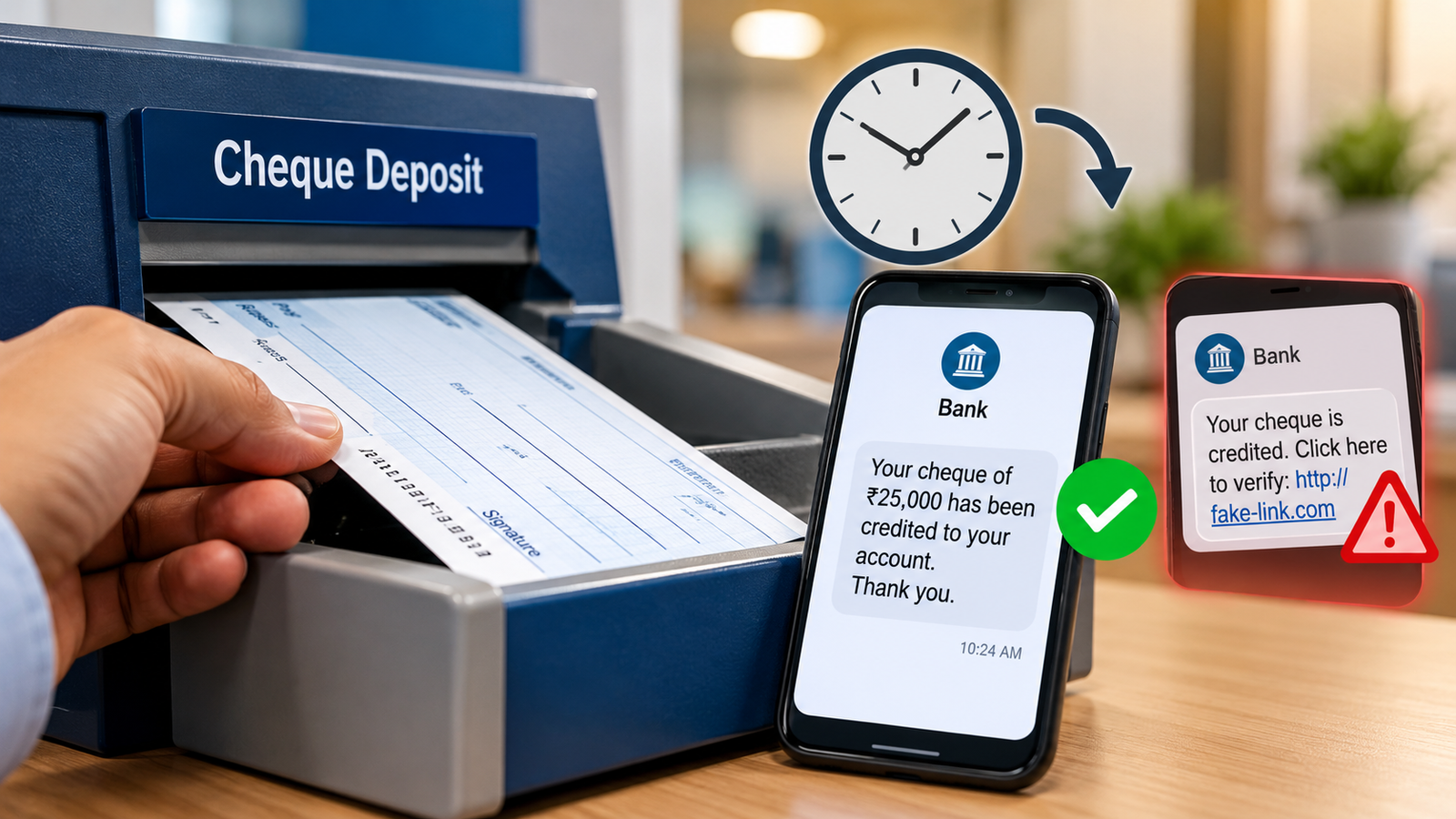
Quick Answer-: A cheque deposit message is your bank’s SMS confirming it has received your cheque for clearing. It does not mean the money is in your account yet. Under RBI’s continuous clearing system, a cheque presented between 10 AM and 4 PM is confirmed by the paying bank within 3 clear hours, and the funds are credited within one hour of settlement.
I get this question often, because the same SMS can mean “received”, “under process,” or “credited” depending on its wording. In this guide, I explain each cheque deposit SMS, the timeline that applies today, and how I separate a genuine bank alert from a fake one.
Table of Contents
ToggleQuick Summary
- A cheque deposit message means “received for clearing”, not “money credited”.
- Since 3 January 2026, drawee banks must confirm or reject a cheque within 3 clear hours of presentation.
- The presenting bank must credit your account within one hour after settlement.
- A genuine alert names your cheque number or the last digits of your account. It never asks you to click a link.
- A returned-cheque SMS gives you a reason. Read it before you redeposit.
- A “deposit” SMS that asks for a UPI PIN, OTP, or “approval” is a scam.
What Is a Cheque Deposit Message?
A cheque deposit message is an automated SMS or app notification from your bank. It confirms that your branch, drop box or mobile app has accepted a cheque and sent it into the clearing process.
The message is a receipt, not a payment confirmation. The payment is complete only when you receive a separate credit alert and the amount appears in your passbook or statement.
Why Do Banks Send It?
Banks send it for three reasons:
- To give you proof that the bank accepted the instrument
- To let you spot a wrong amount or wrong account quickly
- To follow RBI’s push for transaction alerts that reduce cheque-related fraud
Deposit Message vs Clearing Message vs Credit Message
| Message type | What it tells you | Is money in your account? |
|---|---|---|
| Deposit or received message | The bank has accepted your cheque for clearing | No |
| Clearing or under process message | The cheque is with the clearing house or paying bank | No |
| Credit message | The cheque is realised, and the amount is added | Yes |
| Return message | The cheque was not honoured | No |
Skim summary: A cheque deposit message is a bank receipt that your cheque entered clearing. It is not a credit alert. Money is yours only when a separate credit message arrives and the balance updates.
What Does Each Cheque Deposit SMS Actually Say?
Wording differs by bank, but most alerts fall into five stages. The samples below are illustrative, not exact bank templates.
| Stage | Sample wording | What I do next |
|---|---|---|
| 1. Received | “Cheque no. 123456 for Rs. 25,000 received for clearing.” | Match the number and amount with my deposit slip |
| 2. Under process | “Cheque no. 123456 is under clearing.” | Wait for the settlement window |
| 3. Credited | “Rs. 25,000 credited to A/c XX1234 by cheque clearing.” | Check the balance and note the date |
| 4. Returned | “Cheque no. 123456 returned unpaid. Reason: funds insufficient.” | Contact the issuer and read the reason code |
| 5. Debit alert (for the issuer) | “Cheque no. 123456 for Rs. 25,000 paid from A/c XX7890.” | Confirm I actually issued it |
What Details Should a Genuine Cheque SMS Contain?
- Cheque number or the last digits of it
- Amount in rupees
- Last four digits of your account number
- Date of the transaction
- The bank’s short name in the sender ID
What Details Should It Never Contain?
- A link to “approve” or “claim” the amount
- A request for your OTP, UPI PIN, card number or password
- A phone number to call for “verification” that is not on your bank’s website
Skim summary: Cheque SMS alerts move through five stages: received, under process, credited, returned and debit. Each should name the cheque number or account digits and the amount. None should carry a link or ask for a PIN.
How Long Does Credit Take After the Cheque Deposit Message?
Credit now usually happens the same day for cheques presented inside the clearing window. Under RBI’s continuous clearing model, cheques are processed as they are deposited rather than in fixed batches, and from 3 January 2026 banks must accept or reject a cheque within 3 hours. After settlement, the presenting bank has to release the customer’s funds within one hour.
How Did the Timeline Change?
Before the change, the CTS clearing cycle could run up to two working days, and RBI moved it to continuous clearing in two phases: 4 October 2025 and 3 January 2026. Here is how the three periods compare.
| Period | Clearing method | Drawee bank confirmation | Credit to you |
|---|---|---|---|
| Before 4 Oct 2025 | Batch clearing | Next clearing cycle | Up to 2 working days |
| 4 Oct 2025 to 2 Jan 2026 | Continuous, one presentation session | By 7 PM the same day | Same day after realisation |
| From 3 Jan 2026 | Continuous | Within 3 clear hours | Within 1 hour of settlement |
Why Is the 10 AM to 4 PM Window Important?
In the first phase, banks scan and send cheques to the clearing house during a presentation session from 10 AM to 4 PM. A cheque deposited after the cut-off is generally picked up in the next session. If I deposit late in the afternoon, I expect credit on the next working day.
Will Every Cheque Clear in 3 Hours?
Not always. The 3 hours is the maximum time for the paying bank to confirm or reject. Your own bank’s branch timing, a Sunday or bank holiday, a mismatch in details, or a bank’s own processing can still add delay.
Say you deposit a Rs. 40,000 cheque at 11 AM on a working day. You should normally see credit that afternoon. If you deposit it at 5 PM on a Friday, I would plan for Monday.
Skim summary: From 3 January 2026, paying banks must confirm cheques within 3 clear hours and the receiving bank must credit within one hour of settlement. The window is 10 AM to 4 PM. Late deposits, holidays and errors can still push credit to the next working day.
How Do I Check My Cheque Status Step by Step?
If you receive a deposit message but no credit, follow these steps in order.
- Note the cheque number and amount from the SMS or deposit slip.
- Open your bank app and look in the transaction history for “cheque deposit” or “clearing”.
- Check your net banking statement for a pending or credited entry.
- Send the bank’s SMS keyword if your bank offers one for cheque status. The keyword differs by bank, so I check my bank’s SMS banking page.
- Call customer care using the number printed on your passbook or the official website.
- Visit the branch with the deposit slip if the cheque is still pending after the expected time.
Where Do I See Status in the App?
Most apps show it under Transactions, Cheques or Service Requests. Some banks list a cheque as “in clearing” until settlement.
What Details Do I Keep Ready?
- Cheque number
- Deposit date and time
- Drawer’s name and bank
- Amount
Skim summary: To check cheque status, match the cheque number, open the bank app or net banking statement, try the bank’s SMS keyword, then call customer care or visit the branch with the deposit slip.
Why Did My Cheque Deposit Message Say “Returned”?
A returned-cheque SMS means the paying bank did not honour the cheque. The message normally includes a reason, and the bank also gives you a cheque return memo.
What Are the Common Reasons?
| Reason | What it means | What I do |
|---|---|---|
| Funds insufficient | The drawer’s account lacks balance | Ask the drawer to fund the account, then redeposit if the cheque is valid |
| Signature mismatch | Signature differs from bank records | Ask the drawer to reissue or confirm the signature |
| Stale cheque | The cheque is older than 3 months | Ask for a fresh cheque |
| Post-dated | Date is in the future | Deposit on or after the date |
| Amount mismatch | Words and figures differ | Ask for a corrected cheque |
| Alteration without authentication | Overwriting without the drawer’s signature | Ask for a fresh cheque |
| Payment stopped or account closed | Drawer stopped payment or closed the account | Contact the drawer, and seek legal advice if needed |
What Do I Do in the First 24 Hours?
- Read the return reason in the SMS and the return memo.
- Contact the person who gave you the cheque.
- Ask for a replacement cheque or a bank transfer.
- Keep the return memo safe. It matters if the issue turns legal.
Can a Bounced Cheque Lead to a Legal Case?
Yes, in some cases. Under Section 138 of the Negotiable Instruments Act, a cheque returned for insufficient funds can lead to a criminal complaint. The usual sequence is:
- You send a written demand notice within 30 days of receiving the return memo.
- The drawer then has 15 days from receiving the notice to pay.
- If the drawer does not pay, you can file a complaint within one month after that period.
The penalty can be imprisonment up to two years, a fine up to twice the cheque amount, or both. I suggest speaking to a lawyer before sending any notice.
Skim summary: A returned-cheque SMS means the paying bank refused the cheque, usually for insufficient funds, signature mismatch or a stale or post-dated cheque. Read the reason, contact the issuer, and consult a lawyer before using Section 138 remedies.
How Do I Know a Cheque Deposit Message Is Real or Fake?
A genuine message matches a cheque you deposited. A fake one usually has a link, urgency or a request for a PIN.
How Do I Check the Sender and Content?
What Does the Sender ID Look Like?
Banks usually send alerts from an alphanumeric header that carries a short form of the bank’s name, not a regular 10-digit mobile number. Treat a plain mobile number claiming to be your bank with caution.
Does the Message Match My Deposit?
A real alert references a cheque number, an amount or the last digits of your account. If I did not deposit any cheque, an alert about one is a warning sign.
Does It Contain a Link or a Request?
A bank cheque alert does not ask you to click, “approve” or “claim” anything. Receiving money never needs your UPI PIN or OTP.
How Do Government Deposit Scams Work?
Fact-checkers found that genuine government cash-transfer messages do not ask people to click a URL and state the name of the scheme under which money was deposited. PIB rated a viral “deposit under a government Yojana” SMS as fake. If a message says money was “deposited” but names no scheme and carries a link, I delete it.
Genuine vs Fake at a Glance
| Check | Genuine bank alert | Fake alert |
|---|---|---|
| Sender | Bank short-name header | Random mobile number or odd header |
| Details | Cheque number, amount, last digits of account | Vague amount, no cheque reference |
| Link | None | “Click to approve or claim” |
| Request | None | OTP, UPI PIN, card details |
| Tone | Factual | Urgent or promising a reward |
| Matches passbook | Yes | No |
What Should I Do If I Get a Fake Message?
- Do not click the link or reply.
- Do not share any OTP or PIN.
- Check your actual balance through your bank’s app or passbook.
- Report the fraud on the National Cyber Crime Reporting Portal at cybercrime.gov.in or call 1930.
- If you already shared details, call your bank immediately to block the account or card.
You can also verify viral claims on PIB Fact Check.
Skim summary: A real cheque deposit message names your cheque or account digits, has no link and asks for nothing. A fake one carries a link, urgency or a PIN request. Verify through your bank app and report fraud at cybercrime.gov.in or on 1930.
How Do I Turn On Inward Cheque Clearing Alerts?
Inward cheque clearing alerts are a different service. They tell you when a cheque you issued is presented for payment, so you can flag a suspicious one fast.
RBI issued a circular on 5 November 2014 titled “Cheque related fraud cases – preventive measures”, and DBS says it offers these inward clearing alerts on request through a branch form. You can read the original on the RBI circular page.
How Do I Register?
Process differs by bank, but the common routes are:
- Submit a registration form at your branch
- Use net banking or the mobile app service request section
- Ask your relationship manager
I confirm that the mobile number on file is current. If an alert shows a cheque I did not issue, I call the bank’s fraud line at once.
Should I Use Positive Pay Too?
Positive Pay lets you confirm key details of a cheque with your bank before it is paid, and banks encourage it for higher-value cheques. Ask your bank about the threshold it applies.
Skim summary: Inward cheque clearing alerts notify you when a cheque you issued is presented. Register through your branch, net banking or relationship manager; keep your mobile number updated, and report any unknown cheque to the bank immediately.
What Should a Business Write in a Cheque Deposit Confirmation Message?
Many searchers want a message to send a customer after receiving a cheque. Keep it short, factual and specific.
Template 1: Cheque Received
- “Hello [Name], we have received your cheque no. [number] for Rs. [amount] dated [date]. It has been sent for clearing. We will confirm once the amount is credited.”
Template 2: Cheque Cleared
- “Hello [Name], your cheque no. [number] for Rs. [amount] has been credited to our account on [date]. Thank you for the payment.”
What Should I Avoid Writing?
- Any link asking the customer to “verify” the payment
- Requests for bank PINs or OTPs
- Claims that payment is complete before the credit appears
Skim summary: A business cheque confirmation should state the cheque number, amount and date, say whether it is received or cleared, and stay free of links and PIN requests. Send the “cleared” message only after the credit appears.
What Mistakes Do I See Most With Cheque Deposits?
- Treating the deposit message as proof of payment and releasing goods early
- Depositing a cheque after the cut-off and expecting same-day credit
- Missing the 3-month validity and presenting a stale cheque
- Not matching the cheque number in the SMS with the deposit slip
- Ignoring a returned-cheque alert until the legal time limits pass
- Clicking links in messages that claim a deposit
Expert Tips I Follow
- Deposit between 10 AM and 4 PM on a working day.
- Photograph the cheque and the deposit slip.
- Check the amount in words and figures before depositing.
- Wait for the credit message before treating the payment as complete.
- Prefer UPI or NEFT for urgent payments. See my guide on digital payments in India for the options, and the Airtel Payments Bank IFSC code page for a worked example of the IFSC details a bank transfer needs.
- If a cheque pays you interest-bearing amounts such as a deposit maturity, understand how bank interest is calculated so you can check the figure.
Skim summary: The most common cheque mistakes are treating the deposit message as payment, missing the 4 PM window, presenting stale cheques, and clicking links in deposit SMS. Match the cheque number, keep slips, and wait for the credit alert.
FAQs: Cheque Deposit Message
What is a cheque deposit message?
It is an SMS from your bank confirming it received your cheque for clearing. It is not a credit alert. For example, if you deposit a Rs. 15,000 cheque and get this message, your balance will not change until the cheque is realised and a credit SMS follows.
How long does a cheque take to clear in India in 2026?
Usually the same working day for cheques presented between 10 AM and 4 PM. Since 3 January 2026, the paying bank must confirm within 3 clear hours and the receiving bank must credit within one hour of settlement. For example, a cheque deposited at 10:30 AM can be credited by mid-afternoon, while one deposited at 5 PM generally waits for the next session.
Does a cheque deposit message mean the money is credited?
No. It means the bank accepted the cheque for processing. Wait for the credit message and check your statement. A person who ships goods after seeing only the deposit SMS risks losing both goods and payment if the cheque returns.
What should I do if I got a cheque deposit message but the amount is not credited?
First, check whether the 3-hour and 1-hour limits have passed and whether you deposited inside the 10 AM to 4 PM window. Then check the app statement, and contact customer care with the cheque number. If you deposited at 4:45 PM on Friday, the delay may simply be the weekend.
Why did I get a cheque deposit message for a cheque I did not deposit?
Treat it as suspicious. Do not click any link. Check your account through the bank’s official app, and if the cheque is real but unknown to you, call the bank’s helpline. If the message only carries a link, report it at cybercrime.gov.in or 1930.
Can a cheque deposit message be fake?
Yes. Scammers copy bank-style wording and add links or PIN requests. A genuine alert gives a cheque number or account digits and asks for nothing. For example, an SMS saying “Rs. 50,000 deposited, click here to accept” is a scam pattern, since receiving money never needs your approval.
What does “cheque under process” mean?
It means the cheque has entered clearing and the paying bank has not confirmed it yet. Under the current system, this stage should be short for cheques inside the window. If it stays unchanged for more than a working day, contact the bank.
What does a returned cheque SMS mean?
The paying bank did not honour the cheque. The reason may be insufficient funds, signature mismatch, a stale or post-dated cheque or an amount error. For example, a cheque dated 10 months ago will return as stale, and the fix is a fresh cheque, not a redeposit.
How do I stop or manage cheque alerts?
Alerts are tied to the mobile number registered with the bank. To change or add the number, use net banking, the branch or your relationship manager. If you want to stop optional alerts, ask your bank, since mandatory transaction alerts may continue.
Is a cheque deposit message proof of payment?
It is proof the bank received the cheque, not proof that the drawer’s bank paid it. Keep the message and the deposit slip, but treat the credit entry as the real proof of payment.
Conclusion
A cheque deposit message is a receipt. It tells you the cheque has entered clearing, and the credit message tells you the money has arrived. With RBI’s continuous clearing in place since 3 January 2026, credit should be credited within hours for cheques presented within the 10 AM to 4 PM window.
I check three things on every cheque SMS: the cheque number matches my slip, the message has no link, and the credit appears in my statement. That habit handles most delays, returns, and fake alerts, and it keeps a cheque deposit message from being mistaken for a completed payment.
Key Takeaways
- A deposit message is a receipt, not a credit.
- Credit is expected within hours for cheques presented from 10 AM to 4 PM.
- Match the cheque number and amount in the SMS with your slip.
- Read the reason code in any returned-cheque alert.
- Never act on a deposit message that has a link or asks for a PIN or OTP.
- Report scams at cybercrime.gov.in or on 1930.
Disclaimer
This article is for general information only and is not legal or financial advice. Cheque clearing timelines, SMS formats, charges, and services vary by bank and may change with RBI directions. Always confirm details with your bank and check official RBI notifications before taking legal or financial action.
