


If you have ever needed cash in a hurry and looked at the gold sitting in your locker, you already understand the appeal of a gold loan. It is one of the fastest ways to raise money in India, and unlike a personal loan, your credit score barely matters. At BusinessMust, we get asked about gold loan interest rates, eligibility, and documentation almost every week, so we decided to put everything in one place, including the RBI rule changes that most articles online have not caught up with yet.
Whether you are a salaried professional trying to cover a medical bill, a small business owner who needs working capital fast, or someone simply comparing gold loan lenders before making a decision, this guide walks you through the whole process. We will also break down the new RBI gold loan rules that come into effect from April 2026, because they genuinely change how much you can borrow and what lenders can and cannot do.
What Is a Gold Loan and How Does It Work?
A gold loan is a secured loan where you hand over your gold jewellery or coins to a bank or NBFC, and they lend you a percentage of its current market value. Your gold stays locked in the lender’s vault until you repay the loan, and once you clear the dues, you get it back exactly as you gave it.
Here is how the process actually plays out. You walk into a branch or apply online, an appraiser checks the purity and weight of your gold, the lender calculates your loan amount based on the Loan to Value ratio, and once you agree to the terms, the money lands in your account, often within the same day. There is no waiting for salary slips to get verified or credit bureau reports to come back clean.
This is exactly why gold loans have become the go-to option for people who need emergency funds. A wedding expense that suddenly needs covering, a hospital bill that cannot wait, or a business owner who needs quick working capital to fulfil an order, these are the everyday situations where a gold loan makes more sense than any other borrowing option.
New RBI Gold Loan Rules 2026: What Every Borrower Must Know
This is the part most gold loan guides online are missing, and it matters a lot if you are applying anytime soon. The Reserve Bank of India released its final circular on gold loans in June 2025, and the rules become mandatory for all banks, NBFCs, cooperative banks, and housing finance companies from April 1, 2026.
Here is what changes for you as a borrower.
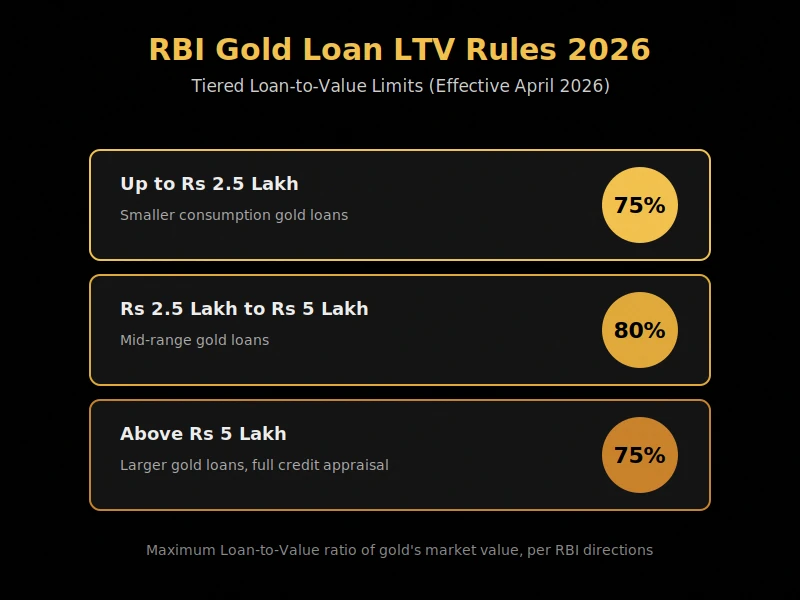
Tiered LTV limits. Instead of one flat cap, the loan amount you can get now depends on your loan size. For gold loans up to Rs 2.5 lakh, you can get up to 75% of your gold’s value. For loans between Rs 2.5 lakh and Rs 5 lakh, the cap rises to 80%. Above Rs 5 lakh, it comes back down to 75%. This tiered structure was designed to help smaller borrowers get more value from the same gold.
LTV has to be maintained throughout the loan. Earlier, lenders only checked the LTV ratio at the time of sanction. Now they have to maintain it through the entire tenure. If gold prices drop sharply and your LTV crosses the allowed limit, the lender can ask you to either pledge more gold or repay part of the loan.
Bullet repayment loans are capped at 12 months. If you choose to pay the full amount, including interest, at the end of the tenure instead of monthly instalments, that tenure cannot exceed 12 months, though it is renewable after you clear the interest due.
Only genuine gold qualifies. The new rules only allow gold jewellery, ornaments, and coins of 22 carat purity or higher that were purchased from a bank, within specified weight limits. Bullion, gold bars, gold ETFs, and gold backed mutual funds are explicitly not accepted as collateral anymore.
Stronger auction protections. If a borrower defaults, lenders now have to follow stricter disclosure norms before auctioning the pledged gold, giving borrowers more transparency and time.
Simpler process for small borrowers. For gold loans up to Rs 2.5 lakh, lenders are no longer required to run detailed income assessments or formal credit checks, as long as the gold itself is genuine. This is a big relief for farmers, informal sector workers, and households who rely on gold loans during emergencies.
If you are applying for a gold loan closer to April 2026, expect lenders to be a little more thorough with documentation and valuation as they adjust their internal systems to these rules. That said, the changes overall work in favour of the borrower.
Gold Loan Interest Rates 2026: Bank vs NBFC Comparison
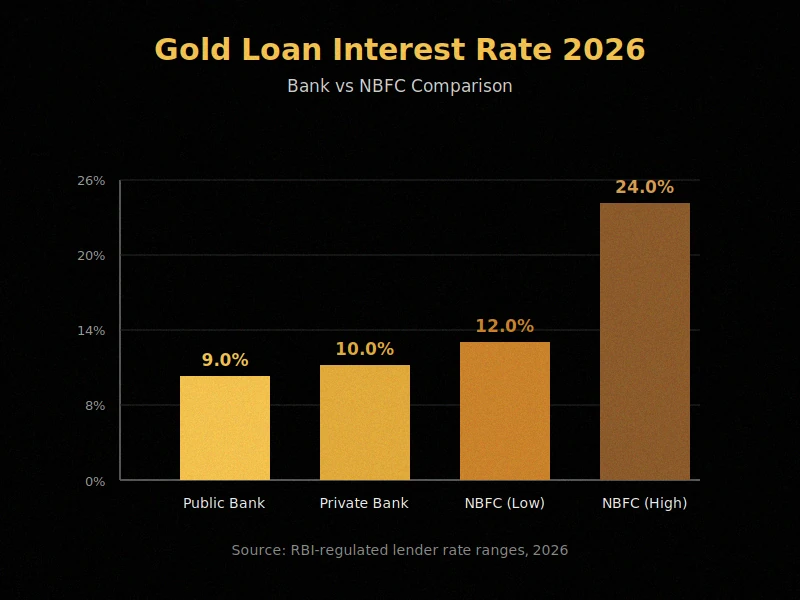
One thing that surprises a lot of first-time borrowers is how much the interest rate can vary depending on where you apply. Banks and NBFCs are not playing the same game here, and knowing the difference can save you a significant amount over the loan tenure.
| Lender Type | Typical Interest Rate | Processing Fee | Speed of Disbursal | Best Suited For |
|---|---|---|---|---|
| Public Sector Banks (SBI, Bank of Baroda) | 8.5% to 9.5% p.a. | Nil to 1% | Same day to 2 days | Lower rates, larger amounts |
| Private Banks (ICICI, HDFC) | 9.0% to 10.5% p.a. | 1% to 2% + GST | Same day | Existing customers, digital process |
| Gold Loan NBFCs (Muthoot, Manappuram, IIFL) | 12% to 24% p.a. | Varies by scheme | Within hours | Fast cash, rural and semi-urban reach |
Banks usually offer the lowest interest rates, which makes sense since they have lower operating costs and stricter risk models. NBFCs charge more, but they make up for it with faster processing, wider branch networks in smaller towns, and often more flexible eligibility.
A quick tip that most people miss: always compare the effective annual cost, not just the headline interest rate. Processing fees, valuation charges, and any prepayment penalties can change the real cost of your gold loan quite a bit. If two lenders quote 9% and 9.5%, but one charges 2% processing fees and the other charges nothing, the cheaper looking rate might actually cost you more.
Gold Loan Eligibility Criteria
The eligibility bar for a gold loan is refreshingly low compared to personal loans, which is exactly why it works so well for people with low credit scores or no formal income proof.
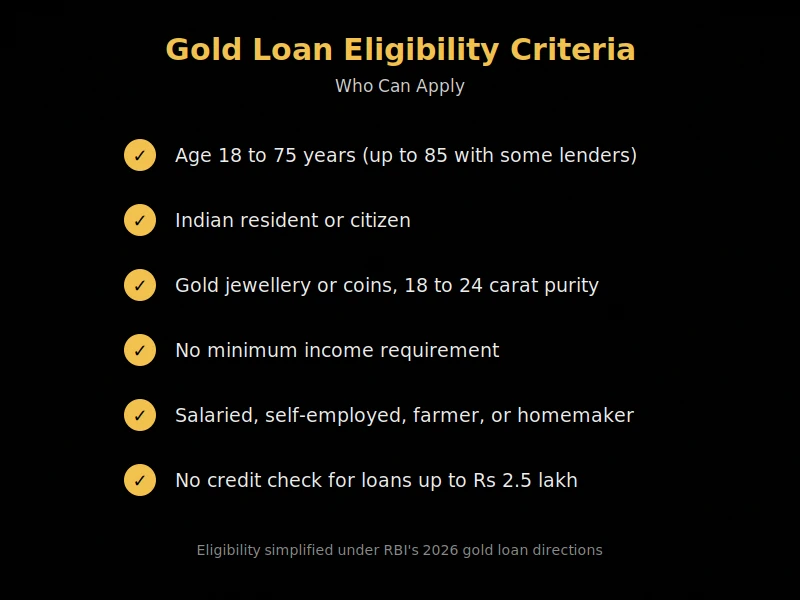
Here is what most lenders look for:
- Age between 18 and 75 years, though some lenders extend this up to 85
- Indian resident or citizen
- Gold jewellery or coins of 18 to 24 carat purity, depending on the lender
- No minimum income requirement for most gold loans
- Open to salaried employees, self-employed professionals, business owners, farmers, homemakers, and pensioners
Under the new RBI rule, borrowers applying for gold loans up to Rs 2.5 lakh do not need to go through a formal credit check or detailed income assessment, as long as the gold pledged is genuine. This is particularly good news for rural borrowers and first-time gold loan applicants who might not have an established credit history.
For higher loan amounts, lenders will typically ask about your repayment capacity even though they do not demand income proof in the same way a personal loan would.
Documents Required for a Gold Loan
The documentation for a gold loan is minimal, and this is one of its biggest advantages. Here is the standard checklist across most banks and NBFCs.
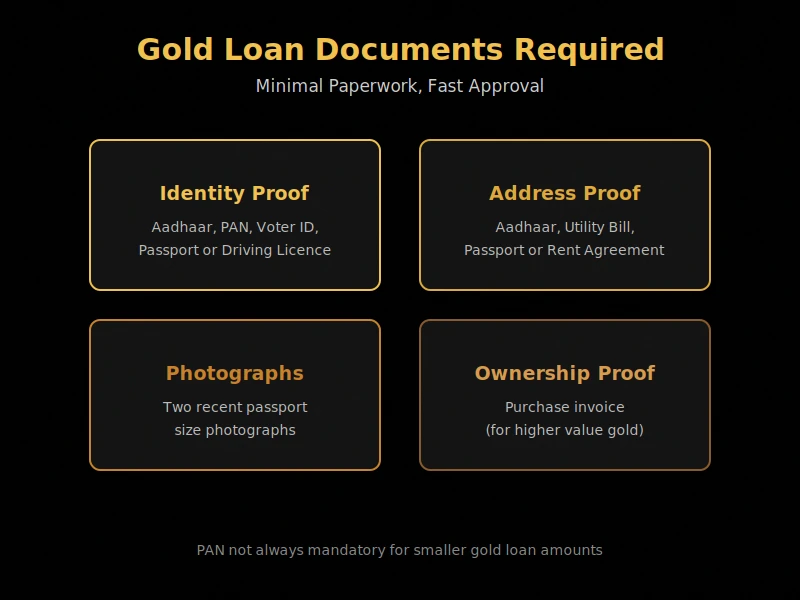
Identity proof: Aadhaar card, PAN card, voter ID, passport, or driving licence
Address proof: Aadhaar card, utility bill, passport, or rent agreement along with the latest owner’s electricity bill
Photographs: Two recent passport-size photographs
Ownership proof for gold: Not always mandatory, but some lenders may ask for a purchase invoice, especially for higher value pledges
A PAN card is not always compulsory for smaller gold loans, but you will still need to satisfy basic KYC requirements. Self-employed individuals or farmers applying for agriculture gold loans might need a land ownership document or similar proof depending on the lender’s policy. It is always worth checking the exact list on your chosen lender’s website since requirements can shift slightly between banks and NBFCs.
How to Calculate Your Gold Loan Amount and EMI
The formula behind a gold loan is simple: Gold Value multiplied by the LTV percentage gives you the maximum loan amount.
Let’s walk through a real example. Say you pledge 10 grams of 22 carat gold, and the current market rate is Rs 7,200 per gram. Your gold value works out to Rs 72,000. If your lender offers an LTV of 75%, your maximum gold loan amount would be Rs 54,000.
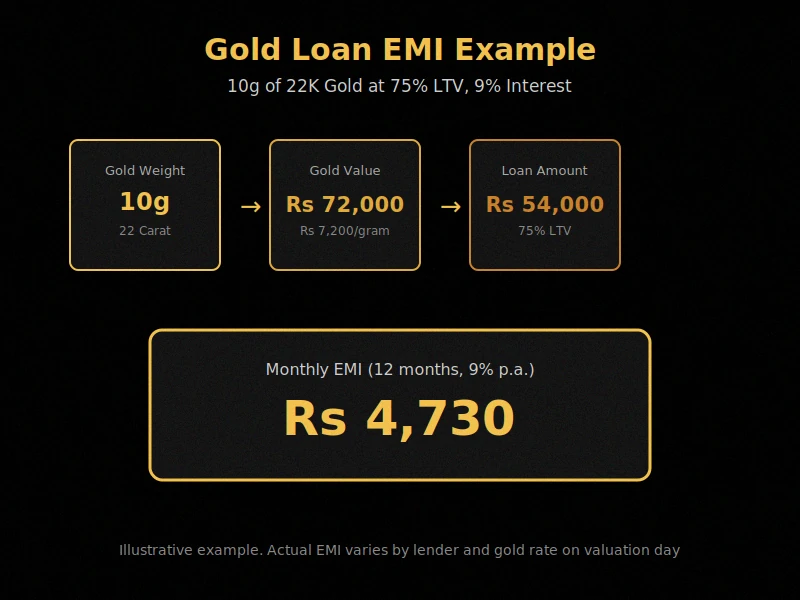
Now let’s say you take that Rs 54,000 loan for 12 months at 9% annual interest, opting for the EMI repayment option. Your monthly EMI would come to roughly Rs 4,730, which includes both principal and interest spread evenly across the tenure.
If instead you choose the bullet repayment option, you would pay the interest monthly or at closure, and repay the full Rs 54,000 principal at the end of the 12 month tenure. This works better for people who expect a lump sum of money coming in later, like a business owner waiting on a large payment.
Keep in mind gold rates change every single day, so the exact loan amount you get will depend on the rate on the day of your valuation. Most lenders offer a gold loan calculator on their website where you can enter your gold’s weight and purity to get an instant estimate before you even walk into a branch.
Gold Loan vs Other Loan Options
If you are weighing a gold loan against other borrowing options, here is how it stacks up.
| Loan Type | Interest Rate | Speed | Documentation | Credit Score Needed |
|---|---|---|---|---|
| Gold Loan | 8.5% to 24% p.a. | Hours to same day | Minimal | Not required for smaller loans |
| Personal Loan | 10.5% to 24% p.a. | 1 to 7 days | Income proof, salary slips | Yes, usually 700+ |
| Loan Against Property | 8% to 14% p.a. | 1 to 4 weeks | Property papers, income proof | Yes |
| Selling Sovereign Gold Bonds | No interest cost | 1 to 3 days | Demat account | Not required |
A gold loan wins when you need cash quickly and do not want to go through a lengthy credit assessment. It also works better than selling your gold outright, since you get to keep ownership and reclaim it once repaid. Where a gold loan falls short is for very large borrowing needs or long repayment tenures, since most gold loans are capped at 12 to 36 months depending on the lender.
Risks of Taking a Gold Loan
Gold loans are convenient, but they are not risk-free, and it is worth understanding what can go wrong before you sign up.
Default and auction risk. If you miss repayments for an extended period, the lender has the right to auction your pledged gold to recover the loan amount. Under the new RBI rules, lenders must follow stricter disclosure norms before doing this, but the risk of losing your gold if you default is real.
Margin call risk. If gold prices fall significantly during your loan tenure, your LTV ratio can breach the allowed limit. In that case, the lender may ask you to pledge additional gold or repay part of the loan to bring the ratio back in line.
Choosing unregulated lenders. Local jewellers or unregulated money lenders sometimes offer gold loans at attractive-sounding rates, but they often lack proper storage security and transparent valuation. Sticking with RBI-regulated banks and NBFCs protects both your gold and your rights as a borrower.
To avoid trouble, keep track of gold price movements during your loan tenure, choose a repayment plan that matches your actual cash flow, and never borrow more than you are confident of repaying comfortably.
How Is Your Gold Valued?
Ever wondered how a bank decides exactly how much your gold is worth? Lenders use a karat meter or XRF testing machine to check the purity of your gold without damaging it. This device measures the exact gold content, which is how a 22 carat necklace gets distinguished from an 18 carat one in seconds.
Only the gold content counts toward your loan value. Any stones, gems, or other attachments on your jewellery are excluded from the weight calculation. So if you are pledging a necklace with stones, only the net gold weight after removing the stone weight gets used to determine your loan amount.
Once the purity and net weight are confirmed, the lender applies the current market rate for that purity level, and then multiplies it by the applicable LTV percentage to arrive at your final loan offer.
Step-by-Step: How to Apply for a Gold Loan
Applying for a gold loan today can be done either at a branch or through a digital process, and both are fairly quick.
- Check your eligibility and estimate your loan amount using a gold loan calculator on the lender’s website
- Fill out the application form, either online or at the branch, and book an appointment if applying digitally
- Visit the branch to hand over your gold for valuation, since most lenders still require this step in person
- Submit your KYC documents, including identity and address proof
- Receive your loan offer based on the appraised value and agree to the terms
- Get the funds disbursed directly into your bank account, usually within a few hours
Digital gold loan applications have made the process noticeably faster in recent years, letting you complete most of the paperwork from home and only requiring a branch visit for the gold handover and valuation.
Expert Tips
- Always compare at least three lenders, including one bank and one NBFC, before finalising your gold loan
- Ask about processing fees and prepayment charges upfront, not just the headline interest rate
- Choose EMI repayment if you have steady monthly income, and bullet repayment if you are expecting a lump sum later
- Keep your loan tenure as short as realistically possible to minimise total interest paid
- Track gold prices during your loan tenure so you are not caught off guard by a margin call
Common Mistakes to Avoid
- Borrowing the maximum amount offered instead of only what you actually need
- Ignoring processing fees, valuation charges, and foreclosure penalties while comparing lenders
- Choosing an unregulated local lender purely because the process feels faster
- Missing EMI payments, which can quickly lead to penalty interest and eventually risk of auction
- Not checking whether your specific gold coins qualify under the lender’s purity requirements
Benefits of a Gold Loan
- Fast approval and disbursal, often within the same day
- Minimal documentation with no income proof required for most loans
- No impact on your credit score if you already have a low or no credit history
- Flexible repayment options including EMI, bullet repayment, and partial payment
- Lower interest rates compared to unsecured personal loans, especially through banks
- You retain ownership of your gold and get it back once the loan is repaid
FAQs
What is the maximum loan amount I can get against gold?
Is a gold loan safe? What happens to my gold?
Can I get a gold loan with a low credit score?
What is the current gold loan interest rate in India?
Can I prepay or foreclose my gold loan early?
What documents are needed for a gold loan?
What happens if I can’t repay my gold loan?
How has the new RBI 2026 rule changed gold loan eligibility?
Conclusion
A gold loan remains one of the fastest and most accessible ways to raise money in India, whether you are covering an emergency expense or funding your business’s working capital needs. With the new RBI rules coming into effect from April 2026, borrowers actually stand to benefit from more transparency, tiered LTV limits, and simpler processes for smaller loans. At BusinessMust, our advice is simple: compare lenders carefully, understand the true cost beyond just the interest rate, and only borrow what you genuinely need. Done right, a gold loan can solve a short-term cash need without disrupting your long-term finances.
Key Takeaways
- A gold loan lets you borrow against pledged gold without selling it, with quick approval and minimal documentation
- New RBI rules from April 2026 introduce tiered LTV limits: up to 85% for smaller loans, 75% for larger ones
- Bank interest rates range from 8.5% to 9.5%, while NBFCs charge 12% to 24%
- No income proof or credit check is required for gold loans up to Rs 2.5 lakh
- Always compare the total cost, including processing fees, not just the interest rate
- Missing repayments can lead to gold auction, so borrow only what you can comfortably repay
Disclaimer: This article is for general informational purposes only and does not constitute financial advice. Gold loan interest rates, LTV limits, and eligibility criteria vary across lenders and are subject to change based on RBI guidelines and market conditions. Please verify current rates and terms directly with your chosen bank or NBFC, and consult a qualified financial advisor before making any borrowing decision.
