


If you have a home loan, or you are about to take one, there is a good chance you have never actually sat down and worked out how much of your EMI goes to the bank as pure profit. Most people just pay whatever the bank tells them to pay, for as many years as the bank says, and never question it. That is the expensive way to do it.
At BusinessMust, we talk to salaried employees, first time buyers, and self employed business owners every week who are surprised to learn that a loan they thought would take 20 years could realistically be closed in 12, just by changing how they repay it. This is exactly the kind of practical, no jargon money talk we believe in, the same spirit behind Talk Money with Pavan. In this home loan repayment guide, we walk you through exactly how to repay smarter, with real numbers, not vague suggestions.
What Is Home Loan Repayment and How Does It Work?
Every EMI you pay is split into two parts: principal and interest. In the early years of your loan, most of your EMI goes toward interest, not principal. This surprises almost everyone.
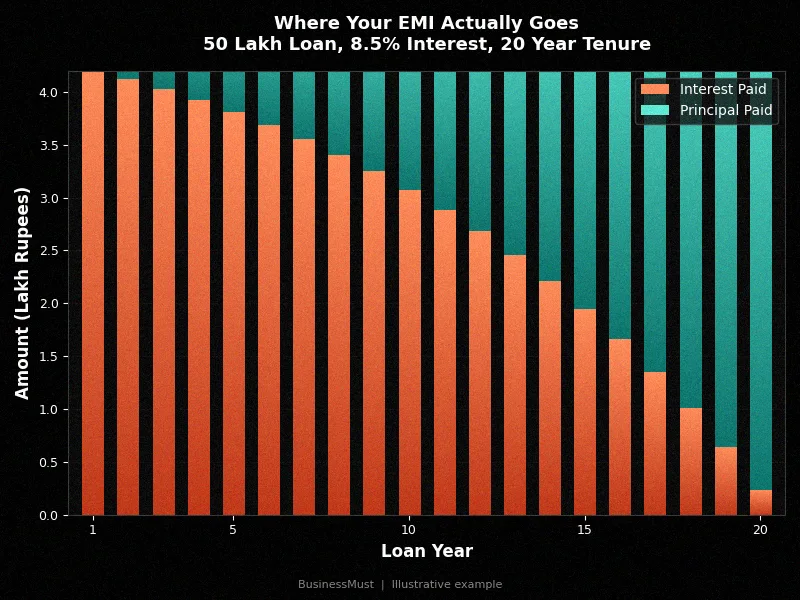
Here is why. Interest is calculated on your outstanding loan balance every month. In year one, your outstanding balance is close to the full loan amount, so the interest portion is high. As years pass and the balance shrinks, more of each EMI starts chipping away at the principal.
Take a simple example. On a loan of 50 lakh rupees at 8.5 percent interest for 20 years, your EMI works out to roughly 43,391 rupees. In the very first month, about 35,417 rupees of that EMI is interest, and only about 7,974 rupees actually reduces your loan. That ratio slowly flips over the years, but it takes time.
This one fact changes everything about repayment strategy. If you prepay early in the loan, you are cutting into the years where interest dominates, so the savings are much bigger than prepaying the same amount later. We will come back to this with real numbers in a bit.
Repayment is not just about paying your EMI on time. It is a set of decisions you can actively make: how much to pay, when to pay extra, and whether to shorten your tenure or lower your EMI. Borrowers who understand this end up paying lakhs less in interest than borrowers who just let the loan run its default course.
Home Loan Repayment Options You Can Choose From
You are not locked into one repayment style for 20 years. Depending on your income pattern and life stage, different options make sense.
Standard EMI is the default. You pay a fixed amount every month for the full tenure. Simple, predictable, and fine if your income is stable and you are not actively trying to optimize.
Step up EMI works well for someone early in their career. Your EMI starts lower and increases every year, usually in line with expected salary hikes. A 25 year old software engineer taking a loan today with modest savings but strong income growth ahead is a good candidate for this.
Step down EMI is the opposite. Your EMI starts higher and reduces over time. This suits someone closer to retirement who wants to clear more of the loan while their income is still strong, before it tapers off.
Prepayment or part payment means putting in extra money beyond your EMI to reduce the outstanding principal directly. This does not close the loan, but it shortens the effective burden.
Full foreclosure means paying off the entire remaining balance in one go and closing the loan completely.
Balance transfer is when you move your loan to another lender offering a lower interest rate. It is not repayment in the traditional sense, but it achieves the same goal, paying less over time.
For self employed professionals and business owners with income that fluctuates month to month, a mix usually works best: standard EMI as the baseline, with opportunistic prepayments whenever there is a good business quarter, rather than committing to a rigid step up schedule.
Prepayment Rules You Need to Know
This is the part almost every other article online gets wrong or leaves out entirely, and it matters a lot.
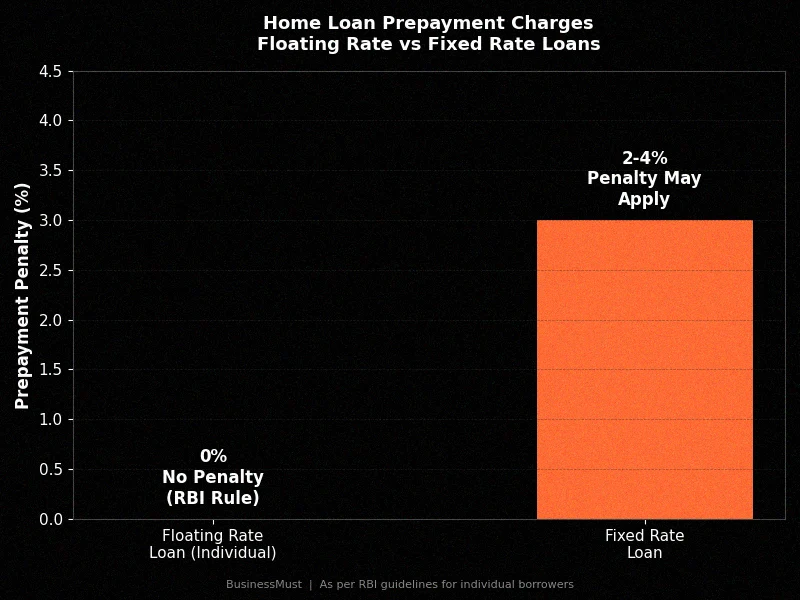
The RBI rule on foreclosure charges. The Reserve Bank of India has directed banks and housing finance companies not to charge any foreclosure or prepayment penalty on floating rate home loans taken by individual borrowers. This applies regardless of the source of funds you use to prepay. If you have a floating rate loan and someone tells you that you will be charged a penalty for prepaying, ask them to point to the exact clause, because for individual borrowers on floating rates, this charge should not exist.
Where charges can still apply. Fixed rate loans are a different story, lenders can and often do charge a prepayment penalty on these, typically between 2 to 4 percent of the amount being prepaid. Some NBFCs and housing finance companies also structure certain loan products differently, so always check your specific loan agreement rather than assuming the floating rate rule automatically covers you.
Minimum prepayment amount and lock in periods. Most lenders set a minimum prepayment amount, often around one EMI’s worth or a fixed sum like 25,000 rupees, and some require the loan to have run for a minimum period, like 6 or 12 months, before you can prepay. This varies by lender, so check your loan agreement or ask your relationship manager directly.
Under construction property loans. If you took a loan for a property that is still under construction, your principal amount actually increases over time as the bank disburses funds in stages, rather than reducing from day one like a normal loan. Prepaying in this situation is more complex, because you are working against a rising principal, not a shrinking one. If this applies to you, talk to your lender specifically about how prepayment interacts with your disbursement schedule.
How to actually do it. Most banks let you prepay through net banking or their mobile app, under a “loan prepayment” or “part payment” section. Some allow UPI for smaller amounts. For larger sums, a branch visit or a request letter might still be needed. After any prepayment, always collect an updated loan statement and revised amortization schedule, and double check it reflects the reduced principal correctly.
Reduce EMI or Reduce Tenure? A Numbers Based Comparison
After you make a prepayment, most lenders give you a choice: keep your EMI the same and reduce your tenure, or keep your tenure the same and reduce your EMI. This decision matters more than most borrowers realize.
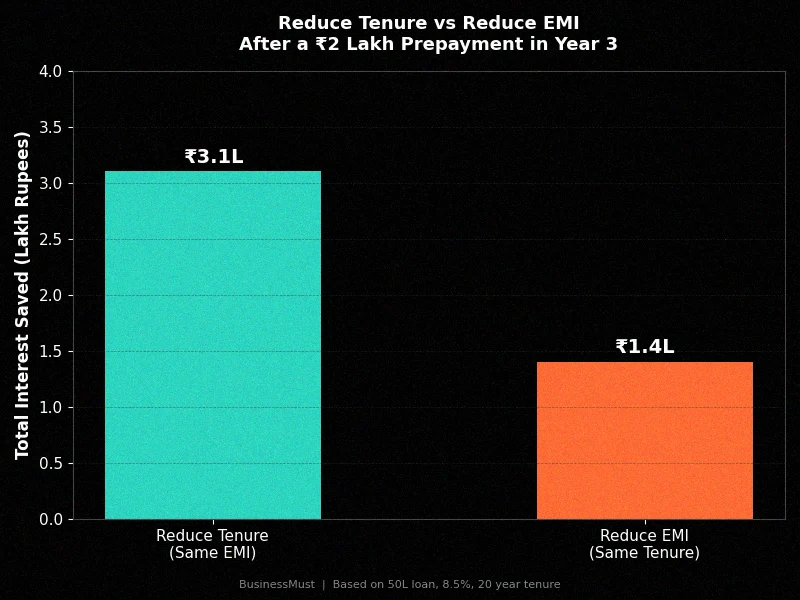
Let’s use a real example. Say you have a loan of 50 lakh rupees, 20 year tenure, 8.5 percent interest. Your EMI is 43,391 rupees. In year 3, you make a prepayment of 2 lakh rupees.
If you choose to reduce tenure and keep your EMI at 43,391 rupees, your loan closes roughly 14 months earlier, and you save approximately 3.1 lakh rupees in total interest over the life of the loan.
If you instead choose to reduce EMI and keep the tenure at 20 years, your new EMI drops to around 41,690 rupees, a saving of about 1,700 rupees per month. Your total interest saved over the loan comes to roughly 1.4 lakh rupees, noticeably less than the tenure reduction option.
The pattern holds true almost every time: reducing tenure saves more total interest, because you are cutting off years where you would have paid interest on a shrinking balance. Reducing EMI helps your monthly cash flow right now, but costs you more over the life of the loan.
So which should you pick? If your monthly budget is genuinely tight and the lower EMI would meaningfully ease pressure, reducing EMI is a reasonable choice. But if you can comfortably manage your current EMI, reducing tenure is almost always the better financial decision. For someone in their 30s or 40s with a stable salaried income, tenure reduction is usually the smarter default. For someone closer to retirement who wants EMIs to shrink as their income might, reducing EMI could make more practical sense.
Should You Prepay Your Home Loan or Invest the Money Instead?
This is probably the single most common question we get, and there is no one size fits all answer, but there is a clear way to think about it.
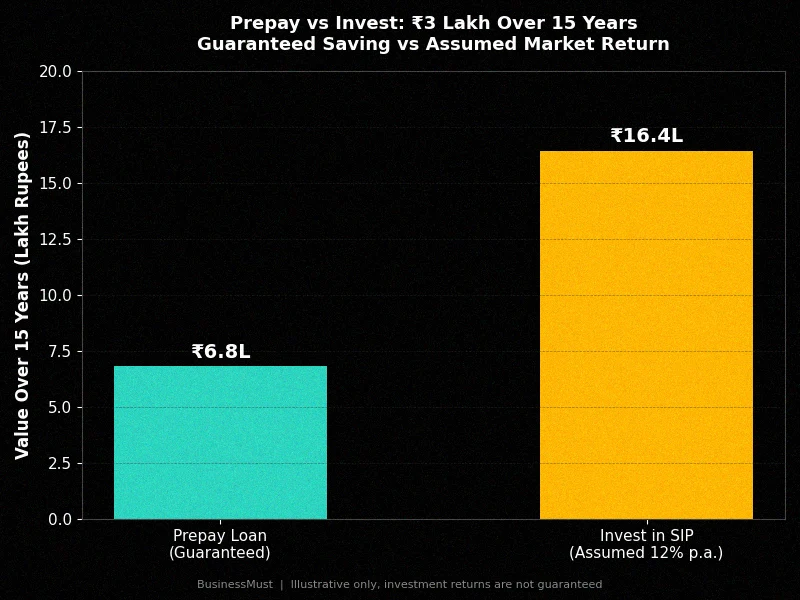
The core comparison is simple in theory: is your home loan interest rate higher or lower than what you could realistically earn by investing that money instead? In practice, it is more nuanced because of tax rules, risk, and liquidity.
Let’s run the numbers. Say your home loan interest rate is 8.5 percent. If you invest the same amount in an equity mutual fund via SIP instead of prepaying, and it returns an average of 12 percent annually over the long term, purely on paper, investing looks better. But this comparison only holds if you are disciplined enough to actually invest consistently, comfortable with market volatility, and not planning to touch that money for at least 7 to 10 years, since equity investments need time to smooth out short term swings.
Here is a real world example. Suppose you have 3 lakh rupees sitting in a savings account. Prepaying this against a 50 lakh, 8.5 percent, 20 year loan in year 5 could save you roughly 6.8 lakh rupees in interest over the remaining tenure, guaranteed. Investing that same 3 lakh rupees in an index fund at an assumed 12 percent annual return for 15 years could grow to approximately 16.4 lakh rupees, though this is not guaranteed and depends entirely on market performance over that period.
The guaranteed saving from prepayment is real and certain. The potential investment return is higher on paper but comes with risk and requires discipline. Neither answer is universally correct.
Before choosing either option, make sure you have an emergency fund covering at least 6 months of expenses. Do not use money earmarked for emergencies to prepay a loan, no matter how good the interest savings look.
The tax regime matters here too, and this is where most advice falls short
Under the old tax regime, home loan interest up to 2 lakh rupees under Section 24(b) and principal repayment up to 1.5 lakh rupees under Section 80C are both deductible, which effectively reduces your real cost of borrowing. Under the new tax regime, which many salaried employees have now shifted to because of lower slab rates, most of these home loan deductions are not available for a self occupied property. If you are in the new tax regime, the tax saving argument for keeping your loan running longer weakens significantly, which tilts the math slightly more in favor of prepaying, since you are not getting a deduction benefit either way.
If you are unsure which regime benefits you more overall, that is worth checking separately, since it affects far more than just your home loan decision.
Tax Benefits on Home Loan Repayment
If you are on the old tax regime, here is what you should know.
Section 24(b) allows a deduction of up to 2 lakh rupees per year on the interest portion of your home loan EMI, for a self occupied property. This is one of the more valuable deductions available to salaried taxpayers.
Section 80C allows a deduction of up to 1.5 lakh rupees per year on the principal repayment portion, though this limit is shared with other common investments like PPF, ELSS, and life insurance premiums, so it fills up quickly for many people.
Under the new tax regime, these deductions are generally not available for a self occupied property, though some benefits may still apply if the property is let out. Since a large number of taxpayers have moved to the new regime for its simpler, lower slab structure, it is worth confirming which regime you are actually filing under before assuming these deductions apply to you.
One practical point that surprises people: as you prepay your loan, the interest component of your future EMIs shrinks, which means your Section 24(b) deduction shrinks too in later years, if you are on the old regime. This is a minor factor, but not a reason to avoid prepaying, since the actual interest you save is almost always worth more than the tax deduction you give up.
Home Loan Repayment Calculator
Numbers only mean something when you plug in your own loan details, not someone else’s example. That is exactly why, as part of our home loan repayment series, BusinessMust and Talk Money with Pavan built a free EMI and prepayment calculator.
Here is what you can do with it:
Enter your loan amount, interest rate, and tenure to see your monthly EMI instantly. Add a prepayment amount and choose whether it is a one time lump sum or a recurring annual prepayment. The calculator shows your revised EMI, revised tenure, and total interest saved side by side, so you can compare reducing EMI versus reducing tenure exactly like we did in the example above, but with your actual numbers.
If you prefer working offline or want to build your own custom scenarios with formulas, we also provide a downloadable Excel version of the same calculator, so you are not limited to just the web tool.
Try a few different scenarios. Test what happens if you prepay 1 lakh every year starting in year 2, versus a single 5 lakh prepayment in year 5. The difference might surprise you.
Common Home Loan Repayment Mistakes to Avoid
Draining your emergency fund to prepay. Interest savings feel great, but they are not worth the stress of having zero buffer if a medical emergency or job loss hits right after you empty your savings.
Prepaying a home loan before clearing costlier debt. If you are carrying a credit card balance at 36 to 42 percent annual interest, or a personal loan at 14 to 18 percent, clear those first. Home loan interest at 8 to 9 percent is comparatively cheap debt, and prioritizing it over expensive debt actually costs you money.
Assuming all loans are penalty free to prepay. As covered earlier, this is only guaranteed for floating rate loans taken by individuals. Fixed rate loans and certain NBFC products can still carry charges, so always confirm before you commit funds.
Not checking the updated loan statement after prepayment. Mistakes happen. Banks occasionally misapply prepayments or delay updating the amortization schedule. Always verify the numbers yourself after any prepayment.
Picking EMI reduction without running the numbers. As we showed above, this often costs you more in total interest than reducing tenure. Make an informed choice, not a default one.
Self employed borrowers overcommitting to aggressive prepayment schedules. If your income varies significantly month to month or season to season, committing to a fixed annual prepayment amount you may not always have available can create cash flow problems. Prepay opportunistically when business is strong, rather than locking into a rigid schedule.
Related FAQs
Is it better to prepay a home loan or invest the money? It depends on your loan interest rate, your investment risk appetite, and your tax regime. If your loan interest rate is higher than what you can safely and consistently earn elsewhere, prepaying usually wins. If you are comfortable with market risk and have a long time horizon, investing can outperform on paper, though it is never guaranteed.
Does prepayment affect my CIBIL score? Prepaying your home loan generally has a positive or neutral effect on your credit score, since it reduces your outstanding debt and improves your credit utilization. It does not damage your score.
Is there a minimum amount required for prepayment? Yes, most lenders set a minimum, often between 25,000 rupees and one EMI amount, though this varies by bank. Check your specific loan agreement.
Can I prepay my home loan via UPI or net banking? Many banks now allow prepayment through net banking or their mobile app, and some support UPI for smaller amounts. For larger lump sum prepayments, you may still need to visit a branch or submit a formal request.
Will I be charged a penalty for prepaying my home loan? If you have a floating rate loan and you are an individual borrower, RBI rules prohibit lenders from charging a foreclosure or prepayment penalty. Fixed rate loans may still carry charges, so confirm your loan type first.
What is the difference between prepayment and foreclosure? Prepayment means paying an extra amount beyond your EMI to reduce your outstanding principal, without closing the loan. Foreclosure means paying off the entire remaining balance at once and closing the loan completely.
Can self employed borrowers prepay as easily as salaried borrowers? Yes, the process itself does not differ based on employment type. The main difference is planning, self employed borrowers should prepay based on actual surplus cash rather than committing to a fixed schedule, given more variable income.
Does prepaying reduce my tenure automatically, or do I have to choose? Most lenders ask you to choose between reducing tenure or reducing EMI at the time of prepayment. If you do not specify, many banks default to reducing tenure, but always confirm this with your lender rather than assuming.
FAQs
Is it better to prepay a home loan or invest the money?
It depends on your loan interest rate, your investment risk appetite, and your tax regime. If your loan interest rate is higher than what you can safely and consistently earn elsewhere, prepaying usually wins. If you are comfortable with market risk and have a long time horizon, investing can outperform on paper, though it is never guaranteed.
Does prepayment affect my CIBIL score?
Prepaying your home loan generally has a positive or neutral effect on your credit score, since it reduces your outstanding debt and improves your credit utilization. It does not damage your score.
Is there a minimum amount required for prepayment?
Yes, most lenders set a minimum, often between 25,000 rupees and one EMI amount, though this varies by bank. Check your specific loan agreement.
Can I prepay my home loan via UPI or net banking?
Many banks now allow prepayment through net banking or their mobile app, and some support UPI for smaller amounts. For larger lump sum prepayments, you may still need to visit a branch or submit a formal request.
Will I be charged a penalty for prepaying my home loan?
If you have a floating rate loan and you are an individual borrower, RBI rules prohibit lenders from charging a foreclosure or prepayment penalty. Fixed rate loans may still carry charges, so confirm your loan type first.
What is the difference between prepayment and foreclosure?
Prepayment means paying an extra amount beyond your EMI to reduce your outstanding principal, without closing the loan. Foreclosure means paying off the entire remaining balance at once and closing the loan completely.
Can self employed borrowers prepay as easily as salaried borrowers?
Yes, the process itself does not differ based on employment type. The main difference is planning, self employed borrowers should prepay based on actual surplus cash rather than committing to a fixed schedule, given more variable income.
Does prepaying reduce my tenure automatically, or do I have to choose?
Most lenders ask you to choose between reducing tenure or reducing EMI at the time of prepayment. If you do not specify, many banks default to reducing tenure, but always confirm this with your lender rather than assuming.
Home loan prepay karna chahiye ya invest karna better hai?
Ye depend karta hai aapke loan ki interest rate aur aapke investment ke risk appetite par. Agar loan ki interest rate zyada hai investment ke expected return se, to prepay karna zyada safe aur faydemand hota hai. Agar aap market risk lene ke liye comfortable hain aur time horizon lamba hai, to invest karna better return de sakta hai, lekin ye guaranteed nahi hota.
Kya prepayment karne se CIBIL score kharab hota hai?
Nahi, prepayment se generally CIBIL score improve hota hai ya neutral rehta hai, kyunki aapka outstanding debt kam ho jaata hai. Isse score kharab nahi hota.
Prepayment ke liye minimum amount kitna hona chahiye?
Zyadatar banks 25,000 rupees se ek EMI amount tak minimum set karte hain, lekin ye har bank ke hisaab se alag hota hai. Apna loan agreement zaroor check karein.
Kya prepayment charges lagte hain?
Agar aapka loan floating rate par hai aur aap individual borrower hain, to RBI ke rules ke mutabik koi prepayment ya foreclosure charge nahi lagna chahiye. Fixed rate loans par charges lag sakte hain, isliye apna loan type confirm kar lein.
Prepayment aur foreclosure mein kya farak hai?
Prepayment ka matlab hai apni EMI ke alawa extra paisa dena taaki principal kam ho jaaye, loan band nahi hota. Foreclosure ka matlab hai poora bacha hua balance ek saath chuka kar loan completely close kar dena.
Self employed logon ke liye prepayment karna mushkil hota hai kya?
Nahi, process same hi hota hai chahe aap salaried ho ya self employed. Bas self employed logon ko fixed schedule ke bajaye jab bhi surplus cash ho tab prepay karna better strategy hai, kyunki income variable hoti hai.
That is our full home loan repayment guide, from BusinessMust and Talk Money with Pavan. Run your own numbers, check your loan type, and make the choice that actually fits your life, not just the default the bank gave you.
Conclusion
Home loan repayment is not something you set once and forget for 20 years. It is a decision you keep making, whether to prepay this year or not, whether to reduce your EMI or your tenure, whether to invest that extra cash instead. Most borrowers never look closely at these choices, and end up paying far more interest than they needed to, simply because nobody explained the math to them clearly. The good news is that none of this requires complex financial knowledge, just a willingness to run your own numbers before deciding anything. Whether you are just starting your home loan journey, sitting a few years in, or planning your very first prepayment, the small decisions you make now around EMI, tenure, and prepayment timing can save you lakhs of rupees by the time your loan is paid off. That is exactly the kind of practical, no jargon money guidance BusinessMust and Talk Money with Pavan aim to give you, so use the calculator, check your loan agreement, and take the next step with actual numbers in hand, not guesswork.
Disclaimer: This article is for general informational purposes only and does not constitute financial, tax, or legal advice. Interest rates, tax rules, RBI regulations, and lender specific policies mentioned here are accurate to the best of our knowledge at the time of writing, but they can change, and individual loan agreements may vary. Investment return figures used in examples are illustrative assumptions, not guaranteed outcomes. Please consult a qualified financial advisor, chartered accountant, or your lender directly before making any home loan repayment or investment decisions. BusinessMust is not liable for any financial decisions made based on this content.
